

Electronic components supply chain – Challenges and solutions

Electronic Components Supply Chain – Challenges and Solutions
Posted: December 04, 2025
In today's interconnected world, electronic components serve as the backbone of countless devices — from smartphones and laptops to industrial machinery and medical equipment. As the demand for these sophisticated devices continues to rise, the electronic components supply chain faces a unique set of challenges that must be met with innovative solutions. Indus Technologies, one of the top pioneering electronic components distributors, is at the forefront of addressing these challenges and revolutionising the supply chain landscape.
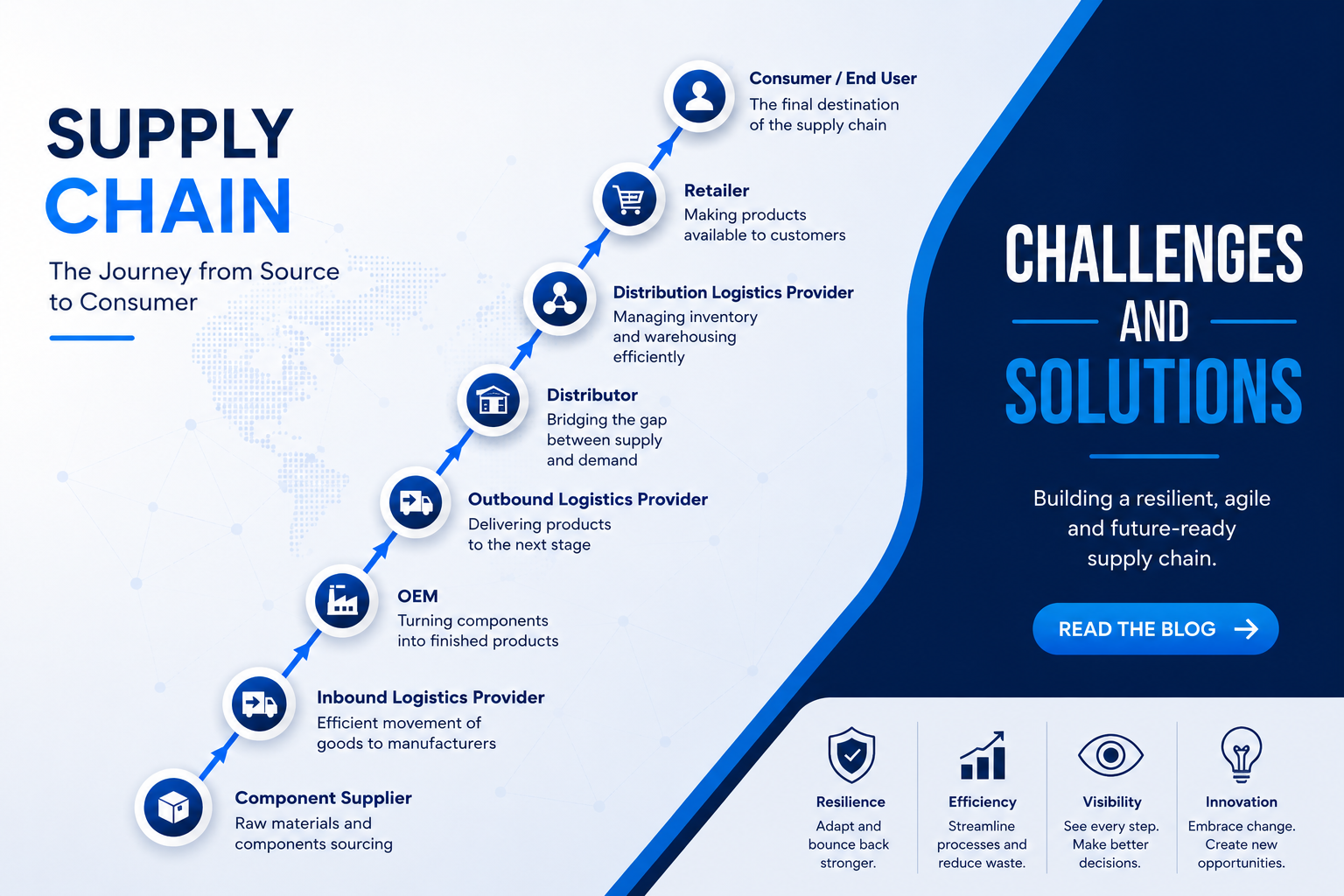
The electronic components supply chain is a vast and intricate network spanning the globe. From semiconductor manufacturers to distributors and end-users, every link in this chain plays a crucial role in ensuring timely delivery. Demand volatility, quality concerns, lead time pressures, and geopolitical disruptions are just some of the headwinds the industry must navigate — and Indus Technologies has built a systematic, proven response to each of them.
Table of Contents
1. The Complex Landscape of the Electronic Components Supply Chain
The global electronic components supply chain is an extraordinarily complex, multi-tiered ecosystem. Raw material extraction, wafer fabrication, component assembly, testing, distribution, and final product integration all span multiple continents — often involving dozens of specialised suppliers, logistics partners, and regulatory environments before a single component reaches an engineer's workbench.
This interdependence, while enabling tremendous economies of scale, also means that a disruption at any single node — a factory shutdown, a shipping delay, a geopolitical embargo — can cascade across the entire chain with amplified consequences. Understanding this landscape is the first step to managing it effectively.
2. Key Challenges Facing the Supply Chain
Demand Volatility
Rapid technological advancements and shifts in consumer preferences create sudden spikes or drops in demand for specific components. A new product launch or an unexpected market trend can leave distributors with critical shortages or costly excess inventory within weeks. This volatility directly impacts production schedules, pricing, and customer satisfaction.
Quality and Counterfeiting
The proliferation of counterfeit, refurbished, and substandard components in the open market is a persistent and costly problem. Fake or out-of-spec parts that enter production lines can cause catastrophic failures in end products — particularly in safety-critical applications such as medical devices, automotive systems, and industrial automation equipment.
Lead Time Pressure
Extended lead times — often stretching to 52 weeks or more for certain semiconductors during peak demand cycles — place immense pressure on procurement teams. Late deliveries delay product launches, erode margins, and damage client relationships. Managing lead times effectively requires real-time visibility across multiple tiers of the supply chain.
Pricing Instability
Component prices can be highly volatile, influenced by raw material costs, currency fluctuations, export controls, and supply-demand imbalances. Procurement teams must balance the risk of committing to fixed pricing against the exposure of spot-market purchasing during price surges.
Single-Source Dependency
Over-reliance on a single manufacturer or distributor creates a critical vulnerability. Any disruption — from natural disasters to factory fires to trade restrictions — can completely halt production if there is no alternative source readily qualified and available.
3. Indus Technologies' Innovative Solutions
In the face of these challenges, Indus Technologies — one of the top electronic components distributors in Bangalore — has emerged as a leader in implementing innovative solutions to streamline procurement and delivery for its clients.
Solution 1 — Diversified Supplier Network
To mitigate the risks associated with single-source dependency, Indus Technologies has built a diversified supplier network spanning multiple manufacturers and authorised distributors globally. By qualifying and maintaining relationships with multiple sources for critical components, the company ensures a more stable and resilient supply — significantly reducing the impact of any single-point disruption.
Solution 2 — Real-Time Demand Forecasting
Indus Technologies leverages advanced data analytics and machine learning algorithms to predict demand patterns accurately. By analysing historical data, market trends, and customer order patterns, the company anticipates fluctuations in demand and adjusts its procurement and inventory positioning accordingly — reducing both shortages and excess stock.
Solution 3 — Just-in-Time Inventory Management
Maintaining large inventories ties up capital and increases storage costs. Indus Technologies adopts a just-in-time inventory approach — electronic components are ordered and received only when needed. This minimises excess inventory and reduces the financial burden of carrying unnecessary stock. Logistics are optimised through three key shipping partners — DHL, FedEx, and UPS — ensuring deliveries consistently arrive before scheduled deadlines.
Solution 4 — Rigorous Quality Control
With over 15 years of industry experience, Indus Technologies maintains strict quality vigilance at every stage of procurement. All components are sourced exclusively from time-tested overseas partners. Every batch is then sent to independent third-party laboratories — including White Horse Laboratory — for verification and testing. This eliminates refurbished, spurious, duplicate, and unauthorised parts from ever reaching a customer's production line, while keeping pricing competitive for all clients.
Solution 5 — Collaborative Partnerships
Recognising the deep interdependence within the supply chain, Indus Technologies fosters collaborative, transparent partnerships with both suppliers and customers. Clear communication channels and shared real-time information help all stakeholders make informed decisions and respond swiftly to changes in demand or supply conditions — turning the supply chain from a reactive system into a proactive one.
Solution 6 — Sustainable Practices
Indus Technologies places a strong emphasis on sustainable practices throughout its supply chain. From responsible sourcing of raw materials to optimising transportation routes for reduced carbon footprint, the company aims to minimise its environmental impact while maintaining the highest standards of efficiency and reliability in component delivery.
4. Challenge vs Solution — At a Glance
| Supply Chain Challenge | Indus Technologies Solution |
|---|---|
| Demand volatility & shortages | Real-time demand forecasting with data analytics & ML |
| Counterfeit & substandard components | Third-party lab testing via White Horse Laboratory |
| Extended lead times | JIT inventory management + DHL / FedEx / UPS logistics |
| Pricing instability | Competitive pricing through long-term authorised partnerships |
| Single-source dependency risk | Diversified global supplier network with multiple qualified sources |
| Poor supply chain visibility | Collaborative partnerships with real-time shared information |
| Environmental impact | Sustainable sourcing & optimised transport routes |
5. Conclusion
The electronic components supply chain is undoubtedly complex — but it is not without solutions. Indus Technologies' proactive approach to addressing each challenge sets a remarkable example for the industry. By diversifying suppliers, employing advanced data analytics, practising just-in-time inventory management, fostering collaborative partnerships, and championing sustainability, Indus Technologies has redefined how electronic components are sourced, managed, and delivered.
As technology continues to evolve, so too will the challenges facing the supply chain. However, with trailblazers like Indus Technologies at the helm, the industry is better equipped than ever to overcome these challenges and usher in a new era of efficiency, transparency, and sustainability. By continuously innovating and adapting, Indus Technologies stands as a trusted partner for businesses reliant on the seamless functioning of the electronic components supply chain.
-

-

November 27, 2025
Connecting the Dots: How Electronic Components Work Together in Devices -

November 27, 2025
How reliable is your electronics components supplier