

AI Hardware at the Edge — Which Microcontrollers & Sensors Are Powering It?

AI Hardware at the Edge — Which Microcontrollers & Sensors Are Powering It?
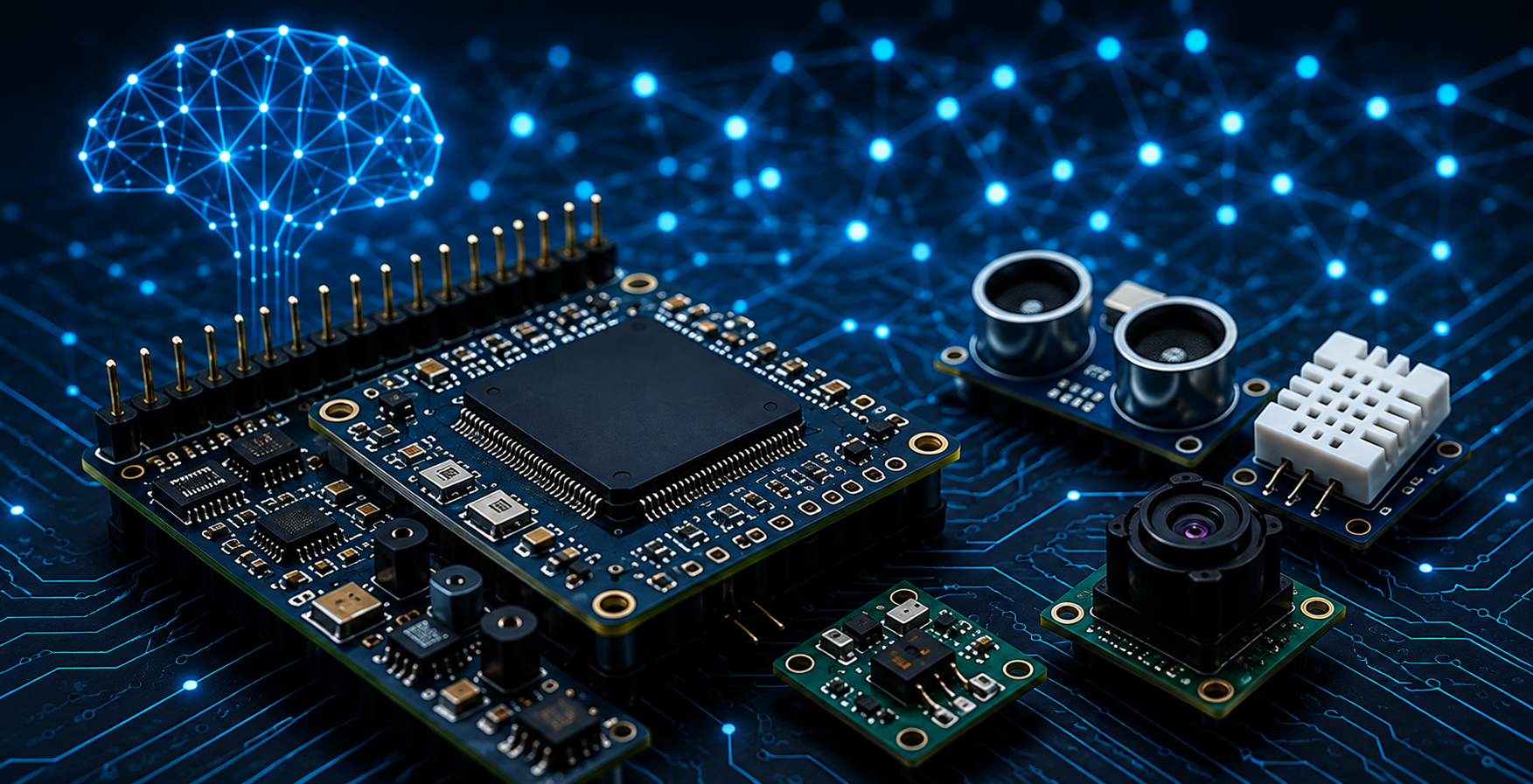
Artificial intelligence is no longer something that only runs in a distant data center. A growing share of AI workloads now happen on the device itself — inside a wearable, a factory sensor node, or a smart camera mounted on a production line. This shift, commonly called Edge AI, is being made possible by two categories of hardware working together: microcontrollers that provide the processing muscle, and sensors that supply the real-world data an AI model needs to make a decision.
For AI hardware teams, startup engineers, and product developers, understanding how microcontrollers and sensors come together to enable Edge AI is becoming essential. Choosing the wrong combination can mean a product that is too slow, too power-hungry, or too expensive to manufacture at scale. This guide walks through the building blocks of Edge AI hardware — from microcontroller architecture to sensor selection to TinyML — so engineering teams can make informed decisions before finalizing a design.
What Is AI at the Edge?
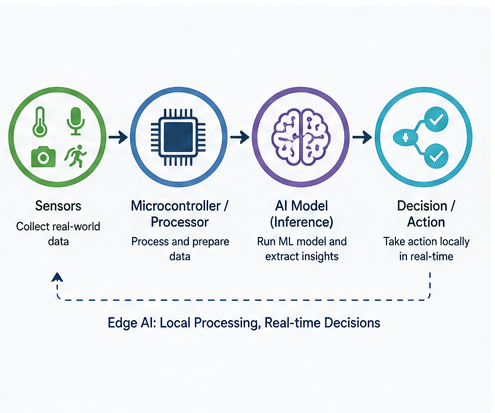
Edge AI refers to running AI inference directly on a local device — a microcontroller, single-board computer, or embedded processor — instead of sending raw sensor data to the cloud for analysis. In a traditional cloud AI setup, a device collects data, transmits it over a network, waits for a server to run the model, and then receives a response. Edge AI collapses that loop: the model runs locally, and a decision is available almost immediately.
"A vibration sensor mounted on a motor continuously measures acceleration. With Edge AI, a small model running on the local microcontroller analyzes the vibration pattern directly and flags an anomaly the moment it appears — without waiting on network round-trips."
This local-processing approach brings several practical advantages: reduced latency for real-time decision making, lower bandwidth usage since raw data doesn't need constant transmission, improved data privacy because sensitive information can stay on-device, the ability to function offline or in low-connectivity environments, better power efficiency for battery-operated products, and reduced recurring cloud infrastructure costs.
Why Edge AI Is Growing
Several trends are pushing AI processing closer to the device. Sensor-rich IoT products are generating more data than networks can economically transport. Manufacturers want real-time responsiveness in robotics, industrial automation, and safety systems, where a network delay is not acceptable. Regulatory and customer expectations around data privacy are pushing companies to process sensitive data locally. At the same time, microcontrollers have become considerably more capable, with more RAM, more flash, and in some cases dedicated hardware acceleration — all while keeping power draw low enough for battery-powered designs.
Role of Microcontrollers in Edge AI
The microcontroller is the compute engine of an Edge AI system. It reads sensor data, runs the inference model, and triggers an output or action. Several hardware characteristics determine whether a given MCU is suitable for an AI workload:
- 1. CPU architecture and clock speed — determines how quickly matrix and vector operations, common in ML inference, can be executed.
- 2. RAM — the model's activations and intermediate buffers must fit within available SRAM, which is often the tightest constraint on small MCUs.
- 3. Flash memory — stores the compiled model weights and application firmware.
- 4. DSP capabilities and hardware acceleration — some MCUs include DSP instructions or dedicated neural processing blocks that speed up inference and reduce power draw.
- 5. Power consumption — critical for battery-powered or energy-harvested designs; active and sleep-mode current both matter.
- 6. GPIO, ADC, PWM, and communication interfaces — determine how easily the MCU can interface with the sensors and actuators the application needs (I2C, SPI, UART, CAN, and similar).
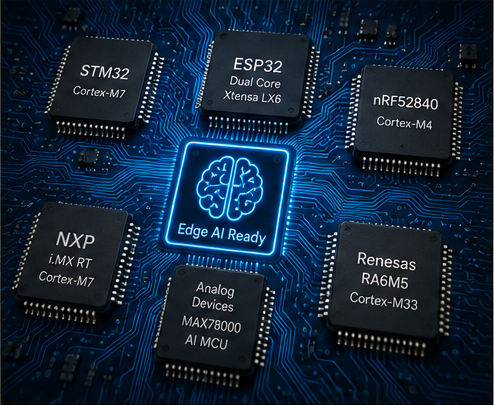
Commonly Discussed MCU Families
It's important not to treat any MCU family as universally "best" for AI. Suitability depends entirely on the specific workload: the size of the trained model, the memory budget, the power envelope, and the required inference speed. A keyword-spotting model that needs to run continuously on a coin-cell battery has very different requirements than a vibration-classification model running on a mains-powered industrial sensor node.
Sensors Powering Edge AI
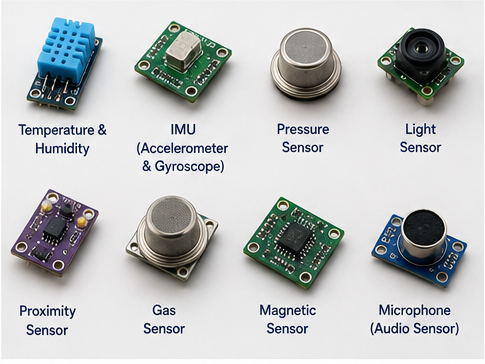
Sensors are the data source an Edge AI model relies on. The quality, resolution, and sampling rate of the sensor data directly affect how accurate the model's decisions can be.
When selecting a sensor for an Edge AI application, engineers typically evaluate measurement range, accuracy and resolution, sampling rate, noise characteristics, and how well the sensor's output interface (analog, I2C, SPI) matches the target microcontroller.
TinyML and On-Device Machine Learning
TinyML is the practice of running machine learning models on extremely resource-constrained hardware — typically microcontrollers with kilobytes of RAM rather than gigabytes. It sits at the intersection of embedded engineering and machine learning, and it is the software layer that makes Edge AI on small MCUs possible.
A model trained on a workstation is typically far too large to run as-is on an MCU. Model optimization techniques such as quantization (reducing numerical precision from 32-bit floating point down to 8-bit integers), pruning (removing redundant weights), and architecture simplification are used to shrink the model until it fits within the target device's flash and RAM budget. Inference time also matters — a model that takes several seconds to produce a result may be unsuitable for a real-time application, even if it technically fits in memory.
These optimizations are not optional extras — they are usually the difference between a model that runs reliably within a device's power and memory budget and one that cannot be deployed at all. Because every kilobyte of RAM and every milliwatt of power is limited on small embedded hardware, model optimization is treated as a core part of the design process rather than an afterthought.
Edge AI Hardware Architecture
Most Edge AI systems follow a similar signal path, regardless of the application:
- 1. Sensor: Captures raw physical data — vibration, temperature, sound, motion, and so on.
- 2. Microcontroller: Reads sensor data through its ADC or digital interface.
- 3. Data processing: Filtering, normalization, and feature extraction prepare the raw signal for the model.
- 4. AI/ML inference: The optimized model evaluates the processed data and produces an output.
- 5. Decision: The result is interpreted against a threshold or classification logic.
- 6. Action: The system responds — triggering an alert, actuating a motor, or logging an event.
Traditional Embedded Processing vs Edge AI
The table below highlights the practical differences between conventional embedded firmware and an Edge AI-enabled design.
| Feature | Traditional Embedded | Edge AI |
|---|---|---|
| Processing | Fixed, rule-based logic | Learned model-based inference |
| Decision Making | Threshold or if-else conditions | Pattern recognition and classification |
| Data Processing | Basic filtering/averaging | Feature extraction plus model inference |
| Connectivity | Often required for any analysis | Optional; can operate offline |
| Latency | Low for simple logic | Low, even for complex pattern detection |
| Cloud Dependency | Varies by design | Reduced for inference; may still sync for training |
| Power Requirements | Typically lower | Slightly higher, but optimized via quantization |
| Use Cases | Simple automation, timers, basic control | Anomaly detection, classification, predictive maintenance |
Important Hardware Selection Parameters
Choosing the right microcontroller and sensor pairing for an Edge AI product involves balancing several parameters simultaneously:
- 1. Measurement range, accuracy, and resolution of the sensor for the target application
- 2. Sampling rate and response time needed for the use case
- 3. Power consumption across active, idle, and sleep states
- 4. Processing requirements — model size, inference frequency, and latency targets
- 5. Available memory (RAM and flash) on the microcontroller
- 6. Communication interface compatibility (I2C, SPI, UART, CAN, wireless)
- 7. Operating temperature range for the deployment environment
- 8. Package size and footprint constraints on the PCB
- 9. Component availability, lead time, and product lifecycle status
- 10. Overall cost at production volume
Component availability and lifecycle deserve special attention for startups and production teams. A microcontroller or sensor that is readily available during prototyping can go end-of-life or face long lead times by the time a product reaches mass production. Designing around parts with a stable lifecycle, and identifying qualified alternates early, helps avoid costly redesigns later.
Practical Edge AI Applications
Challenges and Considerations
Edge AI hardware design comes with real trade-offs. Memory and power constraints limit how sophisticated an on-device model can be. Model updates are harder to deploy across many distributed devices compared to updating a single cloud service. Sensor noise and real-world variability can reduce model accuracy compared to controlled lab conditions. And component sourcing — particularly for specialized sensors or MCUs with AI acceleration — can face longer lead times than mainstream parts, which needs to be planned for during the BOM stage rather than discovered late in development.
How Indus Technologies Supports Edge AI Hardware Development
Building an Edge AI product requires reliable access to the right electronic components, including microcontrollers and sensors from qualified sources. Indus Technologies supports engineering teams working on Edge AI hardware with component sourcing, alternate part identification, and BOM and procurement assistance, helping teams secure the semiconductor components their designs depend on.
For teams navigating component availability challenges — a common issue when specifying MCUs or sensors for AI-enabled products — Indus Technologies' component sourcing and BOM support can help identify qualified alternates and manage procurement timelines so that engineering schedules stay on track.
Conclusion
Edge AI is growing because it solves real problems: latency, bandwidth, privacy, and offline reliability. But none of it works without the right hardware foundation. Microcontroller selection determines how much model complexity a device can handle within its power and memory budget, while sensor selection determines the quality of the data the model has to work with. TinyML techniques like quantization and model optimization bridge the gap between a workstation-trained model and a device with kilobytes of RAM.
For startups and product teams, component availability and lifecycle planning are just as important as technical specifications — a great design on paper is only useful if it can be sourced and manufactured reliably at scale. Teams that approach microcontroller and sensor selection as a system-level decision, rather than choosing each part in isolation, are far better positioned to ship reliable Edge AI products.
FAQs
What is Edge AI?
Edge AI is the practice of running AI inference directly on a local device — such as a microcontroller or embedded processor — rather than sending data to the cloud for analysis.
Which microcontrollers are suitable for Edge AI?
Suitability depends on the workload. MCU families such as STM32, ESP32, ARM Cortex-M based devices, and Nordic Semiconductor parts are commonly used, but the right choice depends on required RAM, flash, power budget, and inference speed for the specific model.
What role do sensors play in Edge AI?
Sensors supply the raw physical data — motion, temperature, sound, pressure, and more — that an on-device AI model analyzes to make a decision. Sensor accuracy and sampling rate directly affect model performance.
What is TinyML?
TinyML is the field of running optimized machine learning models on resource-constrained microcontrollers, using techniques like quantization and pruning to fit models within tight memory and power budgets.
Why is low-power processing important for Edge AI?
Many Edge AI devices are battery-powered or deployed in remote locations. Low-power processing extends battery life and reduces maintenance, making continuous local inference practical over long deployment periods.
Sourcing microcontrollers and sensors for your Edge AI design?
Get BOM and component sourcing support from Indus Technologies.
Request a BOM Quote-

-

November 27, 2025
Connecting the Dots: How Electronic Components Work Together in Devices -

November 27, 2025
How reliable is your electronics components supplier