

BOM Optimisation — Saving Cost Without Compromising Quality

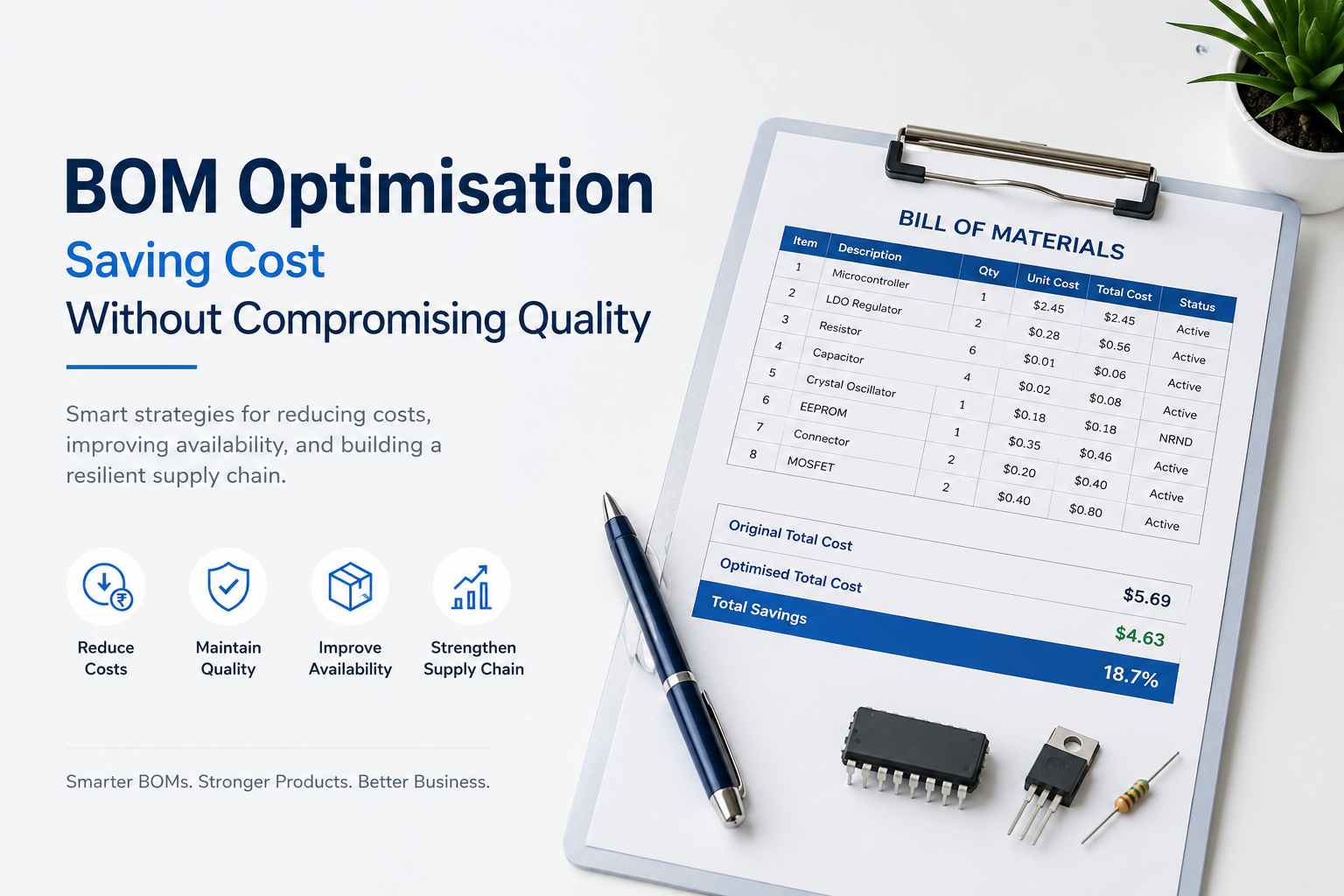
BOM Optimisation — Saving Cost Without Compromising Quality
A practical buyer's guide for procurement teams, product designers, OEMs and EMS companies looking to cut component costs without cutting corners.
Every electronics product starts as a list. Long before the first prototype comes off the line, before the first pick-and-place run, before a single order is placed — there is a Bill of Materials. It is the single document that determines whether a product ships on time and on budget, or gets stuck in a cycle of shortages, re-spins, and rising costs.
In today's electronics industry, that document has become far harder to manage. Component shortages, volatile lead times, sudden end-of-life notices, and price swings on even the most common parts have turned BOM management from a routine procurement task into a strategic function. Teams that treat their BOM as a static list — written once at design freeze and left untouched — are the ones most exposed to cost overruns and production delays.
BOM optimisation is the discipline of continuously reviewing, refining, and validating that list so that cost, availability, and quality stay in balance. Done well, it protects margins without touching the reliability of the end product. This guide walks through what BOM optimisation actually involves, the challenges that make it necessary, and the strategies that procurement teams, designers, and manufacturers can put into practice today.
Table of Contents
- What is a Bill of Materials (BOM)?
- Importance of BOM Optimisation
- Common BOM Challenges
- Cost Optimisation Strategies
- Alternate Components & Lifecycle Management
- Supplier Diversification
- Inventory Optimisation
- Practical Example — Industrial IoT Controller
- How IndusTechno Supports BOM Optimisation
- Best Practices Checklist
- Conclusion
- Frequently Asked Questions
1 What is a Bill of Materials (BOM)?
A Bill of Materials is the structured record of every component, sub-assembly, and raw material required to build a product — resistors, capacitors, ICs, connectors, mechanical hardware, and firmware where applicable. For an electronics product, the BOM is effectively the blueprint that procurement, manufacturing, and quality teams all work from.
A typical BOM includes, for every line item:
- Reference designator and part description
- Full manufacturer part number and manufacturer name
- Package/footprint and quantity per unit
- Approved alternate part numbers, where applicable
- Unit cost and target price
- Lifecycle status (Active, NRND, EOL)
Most organisations work with a few common BOM types:
- Engineering BOM (eBOM): Structured around the design — how the product is engineered.
- Manufacturing BOM (mBOM): Structured around the assembly process — how the product is built.
- Sales/Configurable BOM: Reflects variants and options offered to customers.
A BOM's importance goes far beyond being a shopping list. It directly drives unit cost, production lead time, quality consistency, and how quickly a product can respond to a component shortage. A well-structured, well-maintained BOM is the foundation everything else in this guide builds on.
2 Importance of BOM Optimisation
BOM optimisation is not a one-time cost-cutting exercise — it is an ongoing discipline that pays off across the entire product lifecycle. Here is where the impact shows up:
- Cost reduction: Even small per-unit savings compound significantly across production volumes running into thousands of units.
- Improved manufacturing: Standardised, well-qualified components reduce line stoppages and rework.
- Faster procurement: A clean BOM with verified part numbers and approved alternates moves through quoting and sourcing far faster.
- Reduced lead times: Identifying long-lead items early — instead of at the point of order — avoids production slippage.
- Better quality: Optimisation is not about choosing the cheapest part; it is about choosing the right part at the right cost, which protects reliability.
- Inventory control: A rationalised BOM with fewer unique part numbers is easier to stock, forecast, and manage.
Key Takeaway: BOM optimisation is a balance exercise, not a race to the lowest price. The goal is the lowest total cost of ownership — landed cost, availability, and quality — not just the lowest unit price.
3 Common BOM Challenges
Most BOM-related delays and cost overruns trace back to a small set of recurring issues. Recognising them early is half the battle.
| BOM Challenge | Business Impact |
|---|---|
| Obsolete components | Forced redesign, engineering re-validation, production delays |
| Long lead times | Missed delivery commitments, idle production capacity |
| Single-source risk | Production halts entirely if the sole supplier faces a disruption |
| Counterfeit components | Field failures, warranty claims, brand and safety risk |
| Price fluctuations | Erodes margins, complicates cost forecasting |
| Inventory issues | Excess/dead stock or shortages that stall the production line |
Common Mistake: Treating the BOM as fixed once the design is frozen. Component markets move — a part that was healthy at design time can be constrained or discontinued well before the product reaches end-of-life.
4 Cost Optimisation Strategies
Cost reduction on a BOM should never mean simply switching to the cheapest listed part. The strategies below focus on structural cost improvements that hold up over the life of the product:
- Supplier comparison: Benchmark pricing, lead time, and minimum order quantities across multiple authorised distributors rather than defaulting to one relationship.
- Alternate components: Qualify functionally equivalent parts from a second manufacturer to create pricing leverage and supply flexibility.
- Bulk purchasing: Consolidate volumes across product lines or forecast periods to access better price breaks.
- Standardisation: Reduce the number of unique part numbers across product families — fewer, higher-volume parts typically cost less and are easier to stock.
- Early procurement: Lock in pricing and allocation for long-lead or constrained items well ahead of the production date.
- Design optimisation: Work with engineering to eliminate unnecessary components, combine functions, or simplify circuit design where it does not compromise performance.
| Cost Saving Strategy | Primary Benefit |
|---|---|
| Supplier comparison | Competitive pricing and improved lead-time visibility |
| Alternate components | Supply continuity and negotiating leverage |
| Bulk purchasing | Lower unit pricing at scale |
| Standardisation | Simplified inventory and fewer qualification cycles |
| Early procurement | Protection against price spikes and allocation shortages |
5 Alternate Components & Lifecycle Management
Component lifecycle management is one of the most overlooked areas of BOM optimisation — and one of the most costly to ignore. Every component in your design moves through a lifecycle, and tracking that lifecycle proactively is what prevents last-minute redesigns.
- Approved alternatives: Maintain a pre-qualified list of substitute parts for critical or single-source components, validated by engineering ahead of need.
- End-of-life monitoring: Track manufacturer PCN (Product Change Notification) and EOL announcements so substitutions can be planned, not rushed.
- Product lifecycle awareness: Match component lifecycle expectations to your product's expected market life — a five-year product needs components with a comparable supply horizon.
- Multi-sourcing: Qualify components from more than one manufacturer wherever the design allows, reducing exposure to a single supply chain.
- Engineering validation: Any alternate or substitute part should go through formal engineering sign-off before it is approved on the BOM — cost savings should never bypass quality checks.
| Lifecycle Status | Recommended Action |
|---|---|
| Active | Monitor periodically; no immediate action required |
| Not Recommended for New Designs (NRND) | Begin qualifying an approved alternate for future builds |
| End-of-Life (EOL) announced | Place last-time-buy order or fast-track substitute validation |
| Obsolete | Redesign required or sourcing through verified excess/aftermarket stock |
6 Supplier Diversification
Relying on a single supplier — however reliable they seem — is one of the most common vulnerabilities in a BOM. A regional disruption, an allocation crunch, or a change in that supplier's business priorities can stall your production line overnight.
A diversified sourcing strategy typically includes:
- Working with more than one authorised distributor for critical components
- Qualifying components from at least two manufacturers where the design permits
- Maintaining regional sourcing options to reduce exposure to logistics disruptions
- Building relationships with distributors who offer multi-brand availability under one quoting process
Expert Tip: Diversification is not just about the number of suppliers — it is about having suppliers verified as authorised for the specific parts you need, so risk reduction does not come at the cost of authenticity.
7 Inventory Optimisation
A well-optimised BOM still needs to be matched with a well-managed inventory strategy. Too much stock ties up working capital and risks obsolescence; too little creates production risk. The goal is a balance that supports production without over-committing capital.
- Demand forecasting: Align procurement quantities with realistic production schedules, not worst-case or best-case assumptions.
- Safety stock for critical parts: Hold buffer stock specifically for long-lead or single-source components identified as high risk.
- Just-in-time for high-volume, low-risk parts: Reduce holding costs on commodity components with stable, short lead times.
- Regular BOM-to-inventory reconciliation: Periodically check inventory records against the current, active BOM to catch dead stock early.
8 Practical Example — Industrial IoT Controller
Consider a mid-sized EMS company producing an Industrial IoT controller board for a client, with a planned production run of 5,000 units. At the review stage, the procurement team ran the BOM through a structured optimisation process.
Original BOM issues: The design specified a single-source microcontroller nearing NRND status, a Wi-Fi module with a 22-week lead time, and several passive components sourced from a single regional distributor at above-market pricing.
Actions taken: Engineering qualified a pin-compatible alternate microcontroller from a second manufacturer. The team identified an equivalent Wi-Fi module already in the approved vendor list with an 8-week lead time. Passive components were re-sourced through bulk purchasing across two authorised distributors.
| Metric | Before Optimisation | After Optimisation |
|---|---|---|
| Microcontroller lifecycle risk | NRND, single source | Active, dual-sourced |
| Wi-Fi module lead time | 22 weeks | 8 weeks |
| Passive component cost | Above market average | Reduced via bulk, multi-distributor sourcing |
| Overall unit cost | Baseline | Reduced, with production schedule protected |
Final result: Production stayed on schedule, unit cost came down meaningfully, and the redesigned BOM carried substantially lower lifecycle risk going into the next production run — without any change to the product's field performance.
9 How IndusTechno Supports BOM Optimisation
Optimising a BOM well requires visibility into pricing, availability, and lifecycle status across a wide range of manufacturers — something most in-house procurement teams cannot maintain alone. This is where a sourcing partner adds real value.
IndusTechno works with procurement teams, designers, and EMS companies on several fronts relevant to BOM optimisation:
- BOM analysis: Reviewing a submitted BOM upload line by line to flag pricing outliers, lifecycle risk, and long-lead items before they become production issues.
- Global component sourcing: Access to a wide range of electronic components and semiconductor lines through authorised channels.
- Alternate component suggestions: Flagging qualified, functionally equivalent parts where the original is constrained or approaching EOL.
- Engineering support: Coordinating with design teams on component-level questions through broader engineering services.
- Inventory visibility: Providing clear stock and lead-time data so procurement decisions are based on current availability, not assumptions.
- Procurement assistance: Supporting multi-line BOM quoting for both prototype and production volumes through dedicated procurement services.
- Multi-brand component availability: Comparing options across manufacturers within a single sourcing process rather than requiring separate vendor engagements.
- Lifecycle monitoring: Tracking component status changes over the life of the product so substitutions can be planned rather than forced.
For teams also managing board design or fabrication, the same BOM data connects naturally into PCB design and PCB manufacturing workflows, keeping component selection, board layout, and sourcing decisions aligned from the start.
10 Best Practices Checklist
- Review the BOM against current lifecycle status before every major production run.
- Maintain a pre-approved alternate part for every single-source or constrained component.
- Standardise part numbers across product families wherever engineering allows.
- Track PCN and EOL notifications proactively rather than reactively.
- Compare pricing and lead time across at least two authorised sources for critical parts.
- Reconcile inventory against the active BOM on a regular schedule.
- Route every substitute or alternate component through formal engineering validation.
- Treat BOM optimisation as continuous, not a one-time activity at design freeze.
11 Conclusion
BOM optimisation is not about squeezing every rupee out of a parts list — it is about building a BOM that is resilient, cost-efficient, and easy to manufacture at scale, without ever compromising on quality. The teams that get the most out of it are the ones who treat it as an ongoing process: reviewing lifecycle status regularly, qualifying alternates ahead of need, diversifying suppliers, and keeping inventory aligned with real demand.
Component markets will keep shifting — shortages, price swings, and EOL notices are simply part of the electronics industry now. A proactive BOM strategy, backed by the right sourcing partner, is what turns that volatility from a production risk into something your team can plan around confidently.
12 Frequently Asked Questions
Q1: What is BOM optimisation in electronics manufacturing?
BOM optimisation is the ongoing process of reviewing a Bill of Materials to reduce cost, minimise lifecycle and supply risk, and improve manufacturability, without compromising the product's design intent or reliability.
Q2: How often should a BOM be reviewed?
At minimum, before every major production run, and whenever a component lifecycle change, price shift, or supply disruption is flagged. High-volume or long-life products benefit from a scheduled quarterly review.
Q3: Does using alternate components affect product quality?
Not when the alternate is properly qualified. A functionally equivalent part validated by engineering — matched on electrical, mechanical, and environmental specifications — should perform identically to the original in the application.
Q4: What is the biggest risk in an unoptimised BOM?
Single-source dependency on components nearing end-of-life is typically the highest-impact risk, since it can force an unplanned redesign or halt production entirely once the part becomes unavailable.
Q5: How does BOM optimisation help with inventory management?
Standardising part numbers and rationalising the BOM reduces the number of unique components a business needs to stock, which simplifies forecasting, lowers holding costs, and reduces the risk of dead stock from unused variants.
Suggested Internal Linking Opportunities
- BOM Upload
- Electronic Components
- PCB Design Services
- PCB Manufacturing
- Semiconductor Components
- Procurement Services
- Engineering Services
References
- IPC — Association Connecting Electronics Industries, standards on component quality and traceability
- IEEE — publications on electronic component reliability and supply chain resilience
- SEMI (Semiconductor Equipment and Materials International) — industry data on semiconductor supply trends
- Semiconductor Industry Association (SIA) — market and supply chain reporting
- Gartner — supply chain and procurement strategy research
- McKinsey & Company — electronics and semiconductor supply chain insights
- Texas Instruments — product lifecycle and PCN documentation
- Analog Devices — component lifecycle and obsolescence management resources
- Infineon Technologies — product change notification and lifecycle guidance
Post Photo Gallery
-

-

November 27, 2025
Connecting the Dots: How Electronic Components Work Together in Devices -

November 27, 2025
How reliable is your electronics components supplier