

Global Chip Shortage Lessons — Building Resilient BOM Strategies

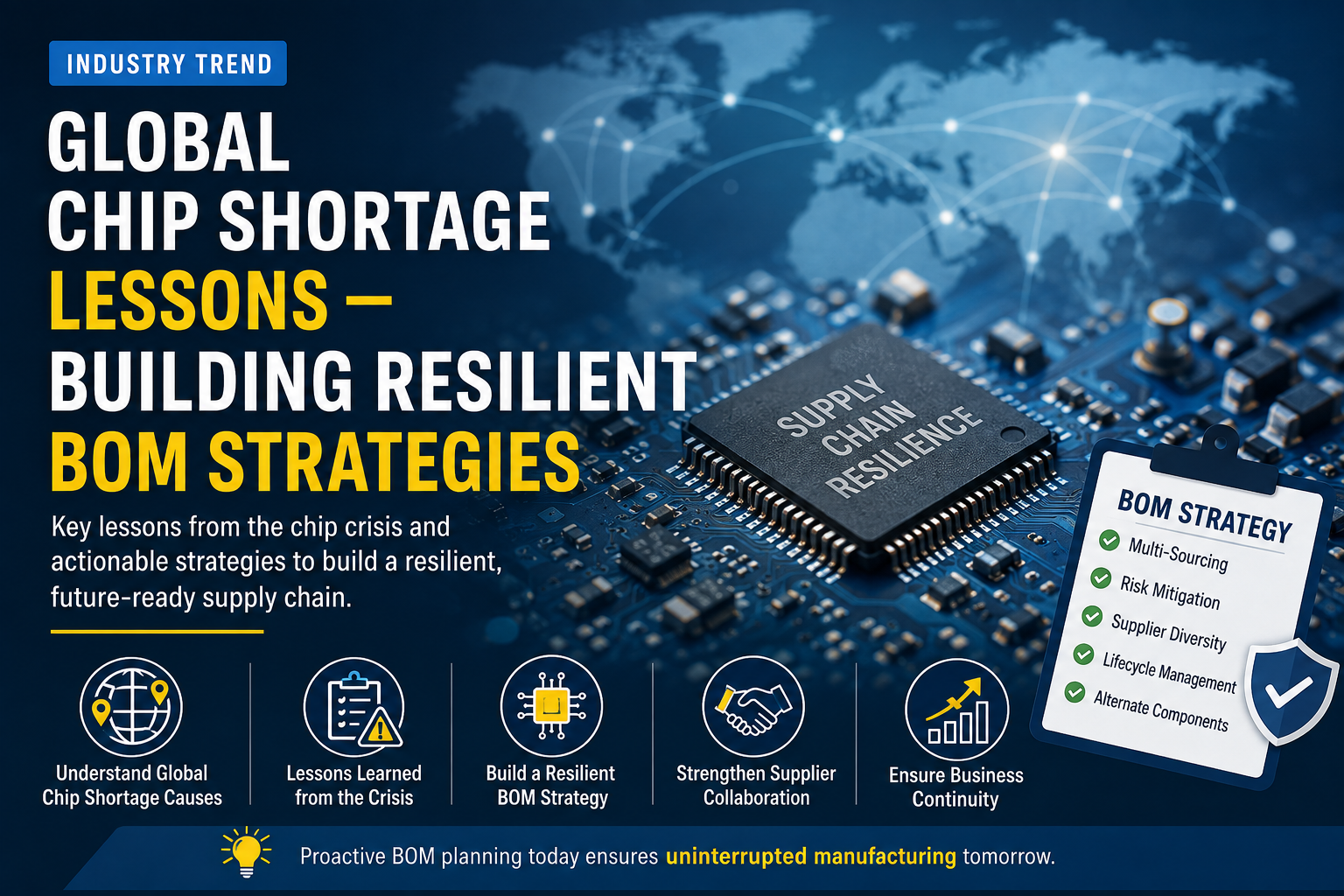
Global Chip Shortage Lessons — Building Resilient BOM Strategies
The global chip shortage did more than stretch lead times — it exposed how fragile a bill of materials can be when it depends on a single supplier, a single region, or a single approved part number. Automotive lines idled, consumer electronics shipments slipped by quarters, and procurement teams that had never touched a broker market suddenly found themselves competing for allocation.
For operations managers, supply chain heads, and procurement teams, resilient BOM planning has since moved from a nice-to-have to a strategic priority. The companies that recovered fastest were rarely the ones that got lucky — they were the ones that had already built flexibility into their sourcing before the crisis hit.
This guide walks through what caused the global chip shortage, the concrete lessons it left behind, and a practical framework for building a resilient BOM strategy — one that holds up the next time supply and demand fall out of balance.
" A BOM built around a single source is not a design decision — it's a risk you haven't priced in yet."
Table of Contents
- Understanding the Global Chip Shortage
- Major Causes Behind the Chip Shortage
- Lessons Learned from the Global Chip Crisis
- Building a Resilient BOM Strategy
- Role of Procurement Teams During Supply Chain Disruptions
- Best Practices for OEMs and EMS Companies
- How IndusTechno Helps Businesses Build Resilient Supply Chains
- Conclusion
- Frequently Asked Questions
Understanding the Global Chip Shortage
The global chip shortage refers to the sustained imbalance between semiconductor supply and demand that disrupted electronics manufacturing across nearly every sector. What began as isolated allocation issues in a handful of component categories quickly spread into a multi-year constraint affecting microcontrollers, power management ICs, discrete semiconductors, and even passive components.
Lead times for parts that once shipped in weeks stretched to twelve months or more in some categories. Industries with tightly scheduled production — automotive, industrial equipment, medical devices, and consumer electronics — were hit hardest, since a single missing component could stall an entire assembly line.
For electronics manufacturers, the impact went beyond delayed shipments. Redesigns, expedited freight, spot-market premiums, and lost production capacity all added cost, and many OEMs and EMS providers were forced to prioritize which products they could actually build with the components available to them.
Major Causes Behind the Chip Shortage
No single event caused the shortage. It was the result of several disruptions converging at once, each amplifying the others:
- Pandemic disruptions: factory shutdowns and workforce shortages reduced fab output while demand patterns shifted abruptly.
- Increased semiconductor demand: growth in consumer electronics, EVs, and 5G devices outpaced available wafer capacity.
- Logistics challenges: port congestion and container shortages extended lead times even for chips already produced.
- Geopolitical factors: trade restrictions and regional concentration of fabrication capacity created single points of failure.
- Manufacturing capacity limitations: new fabs take years to build, so supply could not scale quickly enough to match demand spikes.
The table below summarizes each cause alongside its primary impact on the supply chain.
| Cause | Impact |
|---|---|
| Pandemic disruptions | Reduced fab output and unpredictable demand shifts |
| Increased semiconductor demand | Wafer capacity outpaced by consumer, EV, and 5G demand |
| Logistics challenges | Extended lead times even after chips were manufactured |
| Geopolitical factors | Single points of failure from regional capacity concentration |
| Manufacturing capacity limitations | Supply unable to scale quickly enough to match demand spikes |
Lessons Learned from the Global Chip Crisis
The disruption forced a hard reset on sourcing habits that had gone unquestioned for years. Six lessons stood out.
3.1 Diversify Suppliers
Concentrating purchases with one supplier or one region left many manufacturers exposed the moment that source was disrupted. Spreading sourcing across multiple qualified distributors and regions reduces this single point of failure.
3.2 Avoid Single-Source Components
Designs locked to one part number with no qualified substitute are the most vulnerable line items on any BOM. Flagging single-source risk during the design phase — not after a shortage hits — gives engineering time to qualify alternates on their own schedule.
Industry Insight: Analysts tracking the semiconductor market note that demand from EVs, AI hardware, and industrial automation is likely to keep certain component categories tight even after broad shortages ease — single-sourcing risk isn't going away.
3.3 Improve Forecasting
Longer-horizon, more accurate demand forecasting lets procurement place orders ahead of demand spikes and secure allocation before a shortage becomes critical. Sharing forecasts directly with key suppliers improves planning on both sides of the relationship.
3.4 Strengthen Supplier Relationships
During allocation, manufacturers with established, trust-based supplier relationships were consistently prioritized over transactional, price-only buyers. Long-term partnerships pay off exactly when capacity is constrained.
3.5 Maintain Strategic Inventory
Lean inventory reduces carrying cost, but holding safety stock for high-risk or long-lead-time components provides a buffer that keeps production running through short-term disruptions.
3.6 Use Alternate Approved Components
Pre-qualifying alternate components and maintaining an Approved Vendor List (AVL) for every critical part gives procurement the flexibility to substitute quickly without compromising performance or compliance.
Building a Resilient BOM Strategy
A resilient BOM strategy treats the bill of materials as a living document, reviewed continuously for risk rather than finalized once at design sign-off. The core elements are:
- Multi-source BOMs: every critical component has at least one, ideally two, qualified alternates from different manufacturers.
- Lifecycle management: tracking each component's lifecycle stage to flag parts approaching end-of-life early.
- Obsolescence monitoring: automated alerts for product change notifications (PCNs) and end-of-life (EOL) announcements.
- Approved vendor lists: a vetted list of manufacturers and distributors per component to speed up sourcing decisions.
- Cross-functional collaboration: shared visibility between engineering, procurement, and quality so substitutions don't compromise design intent.
- Digital BOM management: centralized, real-time data on availability, pricing, and lifecycle status, replacing static spreadsheets.
- Design flexibility: footprints and circuits that can accommodate multiple component families, reducing switching cost.
Traditional BOM Strategy vs Resilient BOM Strategy
| Traditional BOM Strategy | Resilient BOM Strategy |
|---|---|
| Single-source components | Multi-source, pre-qualified alternates |
| Static, spreadsheet-based BOM | Digital BOM with real-time lifecycle data |
| Reactive obsolescence handling | Proactive obsolescence monitoring |
| Siloed procurement decisions | Cross-functional design and sourcing collaboration |
| Lean, just-in-time inventory only | Strategic safety stock for high-risk parts |
Risk vs Mitigation Strategy
| Risk | Mitigation Strategy |
|---|---|
| Single-source dependency | Qualify alternate components from multiple manufacturers |
| Sudden lead time extension | Maintain strategic safety stock and blanket orders |
| Component obsolescence | Proactive lifecycle and PCN/EOL monitoring |
| Counterfeit parts in open market | Source through franchised distributors with traceability |
| Limited visibility into supplier capacity | Strengthen direct supplier relationships and forecasting |
Expert Tip: Don't wait for a long-lead-time warning to look for alternates. By the time a part shows up on an allocation list, competitors are already sourcing the same substitutes.
Role of Procurement Teams During Supply Chain Disruptions
Procurement teams sit at the center of supply chain risk management. During a disruption, their role expands well beyond placing orders. Effective teams typically:
- Continuously monitor lead times across the BOM and flag emerging risks early.
- Renegotiate allocation and pricing directly with key suppliers rather than relying on brokers.
- Escalate critical shortages to engineering for substitution decisions before they become production blockers.
- Communicate realistic delivery timelines to internal stakeholders and customers.
- Build direct relationships with franchised distributors and manufacturers to reduce counterfeit and pricing risk.
Procurement teams that treat these responsibilities as ongoing practice — not crisis-only measures — are consistently better positioned when the next disruption hits.
Best Practices for OEMs and EMS Companies
Run through this checklist regularly — not just when a shortage is already underway:
| ✓ | Best Practices Checklist — OEMs & EMS Companies |
|---|---|
| ☐ | Conduct regular BOM risk assessments to flag single-source and long-lead-time components |
| ☐ | Build design flexibility into new products from the earliest schematic stage |
| ☐ | Establish blanket purchase orders or minimum order agreements with key suppliers |
| ☐ | Maintain an up-to-date Approved Vendor List with verified alternate components |
| ☐ | Invest in digital BOM management tools that track lifecycle status and availability |
| ☐ | Collaborate closely with EMS partners to align sourcing strategy with production schedules |
| ☐ | Review and update the BOM risk profile quarterly, not just at product launch |
How IndusTechno Helps Businesses Build Resilient Supply Chains
IndusTechno supports OEMs and EMS companies in strengthening electronic component sourcing through a combination of global reach and hands-on procurement support:
- Global sourcing: access to suppliers across multiple regions, reducing dependence on any single source.
- Component availability: real-time visibility into stock so sourcing decisions reflect actual availability.
- Alternate part recommendations: substitutes that meet the same technical and compliance requirements.
- Procurement support: help consolidating orders and tracking availability across long-lead-time parts.
- BOM analysis: identifying single-source and high-risk parts within an existing design.
- Supplier network: established relationships that support prioritized allocation during tight markets.
- Inventory visibility: up-to-date stock data so procurement teams aren't working from outdated figures.
Conclusion
The global chip shortage reshaped how the electronics industry thinks about supply chain risk. Single-source dependencies, reactive sourcing, and static BOMs proved too fragile for a market where demand and capacity can shift without much warning. The manufacturers that recovered fastest had already diversified suppliers, qualified alternates, and built flexibility into their designs before the crisis forced their hand.
Building a resilient BOM strategy isn't a one-time project — it's an ongoing discipline combining multi-sourcing, lifecycle monitoring, strong supplier relationships, and close collaboration between engineering and procurement. Start the review now, and the next disruption will be a manageable delay rather than a production stoppage.
Frequently Asked Questions
Q1: What is a resilient BOM?
A resilient BOM is a bill of materials built and managed to withstand supply chain disruptions — including qualified alternate components, active lifecycle monitoring, and design flexibility that reduces dependence on any single supplier or part number.
Q2: How can companies reduce semiconductor supply risks?
Companies can reduce risk by diversifying their supplier base, qualifying alternate components early, maintaining strategic safety stock for critical parts, and building strong long-term relationships with key manufacturers and distributors.
Q3: Why is multi-sourcing important?
Multi-sourcing reduces the risk of production stoppages by ensuring that if one supplier faces a shortage, price spike, or logistics delay, an approved alternate is already qualified and available to keep manufacturing on schedule.
Q4: What tools help BOM management?
Digital BOM management platforms that track component lifecycle status, real-time availability, and pricing across multiple distributors help procurement and engineering teams make faster, more informed sourcing decisions than static spreadsheets.
Q5: How can procurement teams prepare for future shortages?
Procurement teams can prepare by conducting regular BOM risk reviews, building relationships with multiple qualified suppliers, improving demand forecasting accuracy, and working closely with engineering to pre-approve alternate components before a shortage occurs.
Suggested Internal Linking Opportunities
- Electronic Components
- PCB Manufacturing
- PCB Design Services
- BOM Upload
- Procurement Services
- Semiconductor Components
- Engineering Services
References
- SEMI (Semiconductor Equipment and Materials International)
- Semiconductor Industry Association (SIA)
- IPC — Association Connecting Electronics Industries
- Gartner
- McKinsey & Company
- Deloitte
- IEEE
- World Semiconductor Trade Statistics (WSTS)
-

-

November 27, 2025
Connecting the Dots: How Electronic Components Work Together in Devices -

November 27, 2025
How reliable is your electronics components supplier