

How to Avoid Counterfeit Electronic Components When Sourcing

How to Avoid Counterfeit Electronic Components When Sourcing
Sourcing electronic components is already a stressful exercise — lead times, price fluctuations, allocation shortages... and now you have to worry about whether the parts in your hands are even real? Unfortunately, yes. Counterfeit electronic components are a very real and growing problem in the global supply chain. According to data from the IHS Markit Counterfeit Parts Study, the electronics industry loses over $169 billion annually to counterfeit parts. And India — as one of the world's fastest-growing electronics manufacturing hubs — is not immune.
If you have ever placed an order with an unknown broker and received parts that looked slightly "off" — the silkscreen was smudged, the date codes did not match, or the parts failed in testing — you already know this problem exists. This guide is here to help you never go through that again. Indus Technologies is one of the reliable and leading distributors of electronic components across the country.
Table of Contents
- The Problem Nobody Likes to Talk About
- What Are Counterfeit Electronic Components?
- Why Counterfeit Parts Are More Dangerous Than You Think
- Where Do Counterfeit Components Come From?
- How to Identify Counterfeit Electronic Components
- How to Avoid Counterfeit Electronic Components When Sourcing
- Industry Standards and Regulations
- How Indus Technologies Helps You Stay Safe
- Quick Reference Checklist
- FAQ
1. The Problem Nobody Likes to Talk About
Let's be honest — sourcing electronic components is already a stressful exercise. Lead times, price fluctuations, allocation shortages... and now you have to worry about whether the parts in your hands are even real?
Unfortunately, yes. Counterfeit electronic components are a very real and growing problem in the global supply chain. According to data from the IHS Markit Counterfeit Parts Study, the electronics industry loses over $169 billion annually to counterfeit parts. And India — as one of the world's fastest-growing electronics manufacturing hubs — is not immune.
If you have ever placed an order with an unknown broker and received parts that looked slightly "off" — the silkscreen was smudged, the date codes did not match, or the parts failed in testing — you already know this problem exists. This guide is here to help you never go through that again.
2. What Are Counterfeit Electronic Components?
A counterfeit electronic component is any part that is deliberately misrepresented in terms of its identity, authenticity, or performance. This includes:
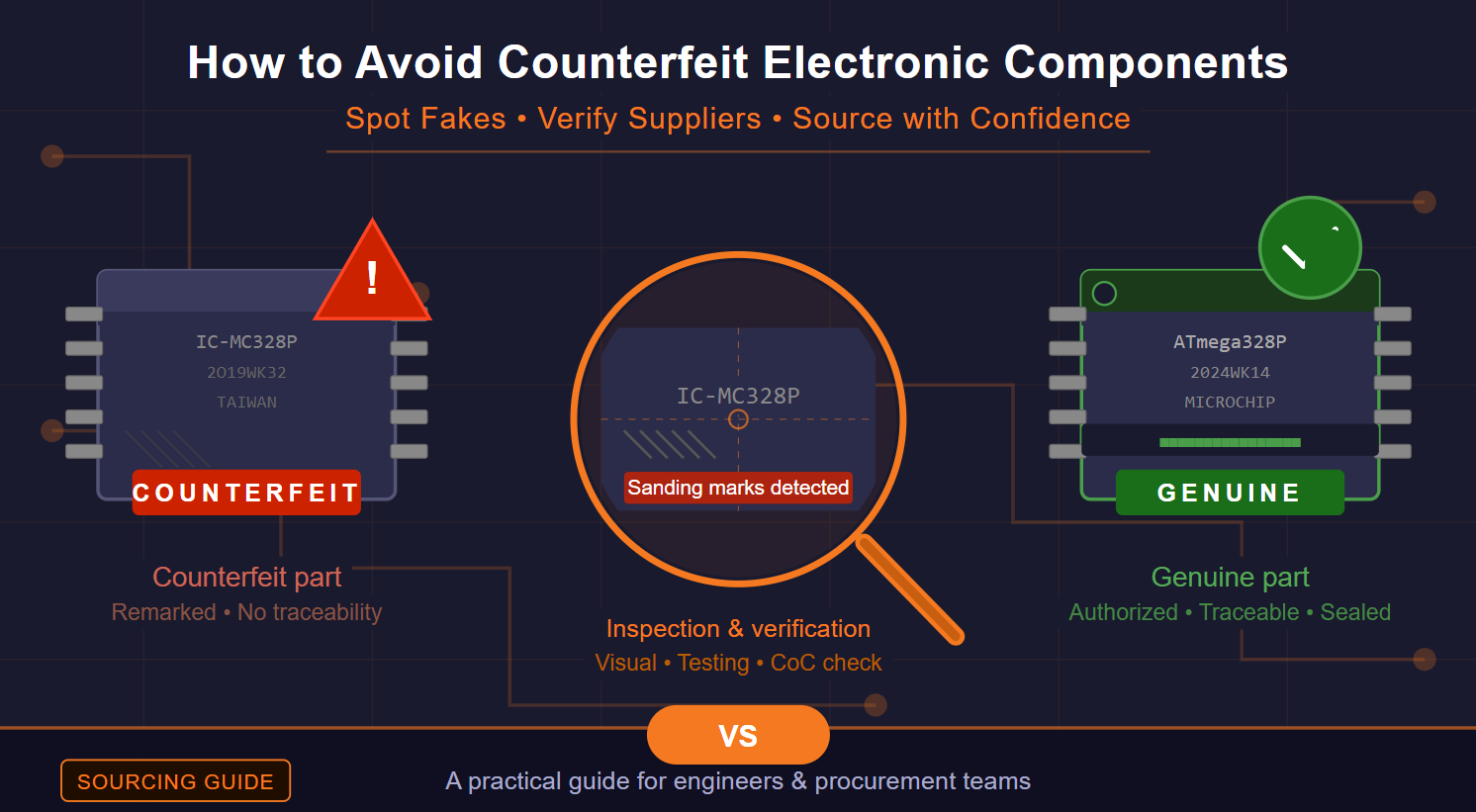
- Recycled components remarked as new — old, used parts are sanded down, re-marked with fresh part numbers, and sold as new.
- Cloned or copied parts — a near-identical copy of the original is manufactured without authorization, often with inferior die quality.
- Overproduced parts — genuine parts manufactured in excess of an authorized order and sold through unauthorized channels.
- Uprated parts — components marked with a higher specification than they can actually meet (e.g., a commercial-grade IC marked as military-grade).
- Defective parts — units that failed QC at the factory, discarded, then recovered and re-sold.
The common thread? They all create a false impression that you are getting a genuine, reliable part — when you are not.
"It's not always about cheap lookalikes. Some of the most dangerous counterfeit electronic components are genuine parts that have been recycled, re-branded, or misrepresented to pass basic inspection."
3. Why Counterfeit Parts Are More Dangerous Than You Think
You might think: "It's just one capacitor" or "It's a passive — how bad can it be?" But here's the thing — in electronics, a single bad part can take down an entire system.
The real-world consequences of counterfeit electronic components are severe:
- Product field failures and costly recalls
- Safety hazards — especially in medical devices, automotive ECUs, and aerospace systems
- Voided warranties and damaged customer relationships
- Legal liability if counterfeit parts cause injury or damage
- Wasted engineering hours diagnosing unexplained failures
In one well-documented case from the US Department of Defense, thousands of counterfeit semiconductors found their way into military hardware — some into aircraft systems. The risks are not theoretical. They are real, and they happen at every level of the supply chain.
4. Where Do Counterfeit Components Come From?
Most counterfeit electronic components enter the supply chain through unauthorized or "grey market" brokers — middlemen who source parts from unverified channels when the original manufacturer or authorized distributor has stock shortages.
Other common entry points include:
- E-commerce marketplaces without proper vetting (open platforms where anyone can list parts)
- Excess stock liquidation from unknown sources
- Third-party sellers offering below-market pricing during component shortages
- Rogue factories in regions with weak IP enforcement laws
The challenge is that during periods of supply shortage — like the global semiconductor crisis of 2021–2023 — procurement teams are under enormous pressure to find parts wherever they can. Counterfeiters know this, and they exploit it.
"The best time for counterfeiters is during a shortage. When legitimate stock runs dry, grey market sellers flood the market — and not all of them are honest about what they're selling."
5. How to Identify Counterfeit Electronic Components
Detection is your first line of defense. Here are the key inspection methods used by electronics professionals to identify suspect or fake components:
5.1 Visual Inspection
Start with your eyes. A surprising number of fake electronic parts can be identified just by looking carefully:
- Check for uneven or blurry silkscreen markings — genuine parts have crisp, consistent printing.
- Inspect lead coplanarity — pins that are misaligned or have excess solder suggest re-tinning of old parts.
- Look for sanding marks on the package surface — a tell-tale sign that original markings have been removed.
- Compare the body dimensions and color against manufacturer datasheets — even tiny differences matter.
- Check for inconsistent finishes or surface oxidation that suggests old or recovered stock.
5.2 Marking & Date Code Verification
Every genuine component carries specific lot codes, date codes, and manufacturer identifiers. Cross-reference these against the manufacturer's records. Many manufacturers, including Texas Instruments, STMicroelectronics, and Infineon, offer online verification tools or can confirm authenticity through their authorized distribution partners.
If the date codes on your reel are inconsistent — some from 2019, others from 2023 — that's a serious red flag.
5.3 Electrical Testing
Functional and parametric testing are essential for mission-critical applications. Test the components at their rated conditions — voltage, current, temperature — and compare measured parameters against datasheet specs. Recycled or cloned parts will often fail these tests, especially at the performance margins.
5.4 X-Ray and Decapsulation
For high-reliability applications — aerospace, defence, medical — consider destructive testing. X-ray analysis can reveal the internal die structure and wiring. Decapsulation (opening the package to expose the die) allows direct verification of the die size, fab markings, and wire bond quality. These methods are expensive but can be essential for safety-critical BOM items.
6. How to Avoid Counterfeit Electronic Components When Sourcing
Detection is good. Prevention is better. Here's how you build a supply chain that keeps fake parts out from the start.
6.1 Buy from Authorized Distributors
This is the single most effective thing you can do. Authorized distributors source directly from manufacturers and carry full traceability from factory to your door. When you buy from an authorized distributor, you get factory-sealed reels, original packaging, and a clear chain of custody.
Grey market sourcing — buying from brokers with no manufacturer authorization — is where most counterfeit parts enter the supply chain. Avoid it wherever possible.
6.2 Verify Certificates of Conformance (CoC)
A genuine Certificate of Conformance documents that the parts meet specified requirements and traces them back to the original manufacturing lot. Always request a CoC with your order, and verify it against the manufacturer's official records when dealing with new suppliers.
6.3 Use Approved Vendor Lists (AVLs)
Maintain an internal Approved Vendor List — a curated list of suppliers that have passed your qualification process. Procurement should default to AVL suppliers and go through a formal approval process before adding new ones.
6.4 Be Wary of Too-Good-To-Be-True Pricing
This one sounds obvious, but during a shortage, when a supplier offers a critically needed IC at 30% below market price with immediate availability, it's tempting to ask fewer questions. Resist that temptation. Counterfeit parts are typically offered at suspiciously low prices precisely because the seller knows they're not the real thing.
6.5 Demand Proper Packaging and Traceability
Genuine components from reputable manufacturers come in original, sealed packaging — factory reels, tube packaging, or dry packs — with proper labels including manufacturer name, part number, quantity, and date code. Ask for photos of the packaging before shipment. Loose parts in generic anti-static bags with no labeling are a warning sign.
Also insist on full traceability documentation: purchase order trail, distributor invoices, and the manufacturer's Certificate of Compliance all the way back to the original factory lot.
???? Practical Tip: Maintain a sample reference library of known-good parts from your most-used components. When new stock arrives, do a side-by-side physical comparison — it takes two minutes and can save your entire production run.
7. Industry Standards and Regulations
The good news: there are well-established industry standards that give you a framework for managing counterfeit risk. Familiarizing yourself with these is valuable whether you're writing a procurement policy or auditing a supplier:
- AS6081 — Fraudulent/Counterfeit Electronic Parts: Avoidance, Detection, Mitigation (Aerospace standard, widely referenced in defence procurement)
- SAE AS5553 — Counterfeit Electronic Parts: Avoidance, Detection, Mitigation, and Disposition
- CCAP-101 — Component Authentication and Anti-Counterfeiting standard from ERAI
- ISO 9001 — General quality management framework; reputable distributors are certified
For a comprehensive overview of global anti-counterfeiting frameworks in electronics, the ERAI (Electronic Resellers Association International) is an excellent resource — they maintain a public database of reported counterfeit and suspect parts that procurement teams can reference before placing orders.
8. How Indus Technologies Helps You Stay Safe
At Indus Technologies, we have built our entire business around one principle: you should never have to wonder if the parts you receive are genuine.
Here's what that means in practice:
- We source directly from manufacturers and authorized distribution channels — never from grey market brokers.
- Every component we supply comes with full traceability documentation, including factory-sealed packaging and Certificate of Conformance.
- We maintain long-standing relationships with our supplier network, so we can verify authenticity at the source — not just at the receiving dock.
- Our quality policy is publicly available, and we operate under strict sourcing standards to protect our customers from fake electronic parts.
Whether you need a single hard-to-find IC or a full BOM supply for production, you can submit an RFQ to Indus Technologies and have our team verify availability through authenticated, traceable supply chains.
We know the frustration of a counterfeit part making it into production. Our job is to make sure that never happens to you.
9. Quick Reference Checklist — Avoiding Counterfeit Electronic Components
| ✓ Sourcing Checklist | |
|---|---|
| ☐ | Always buy from authorized distributors or manufacturers |
| ☐ | Request and verify Certificate of Conformance (CoC) with every order |
| ☐ | Visually inspect marking, finish, and dimensions against datasheet |
| ☐ | Check date codes and lot codes for consistency |
| ☐ | Verify lead finish — look for evidence of re-tinning |
| ☐ | Compare pricing to market — be suspicious of heavily discounted stock |
| ☐ | Insist on original factory packaging (sealed reels, trays, or dry packs) |
| ☐ | Maintain an Approved Vendor List (AVL) and stick to it |
| ☐ | For critical apps, perform electrical parametric testing on incoming stock |
| ☐ | Use ERAI or similar databases to check for reported suspect parts |
| ☐ | Keep a reference sample library of known-good parts for comparison |
10. FAQ — Counterfeit Electronic Components
Final Thoughts
Sourcing electronics is hard enough without the additional headache of fake parts. But the reality is that counterfeit electronic components are a supply chain risk that every engineer, procurement manager, and product company must actively manage.
The good news? With the right practices — buying from authorized sources, demanding proper documentation, doing incoming inspection, and maintaining your AVL — you can protect your designs, your products, and your customers from the damage that fake parts cause.
And if you ever need a sourcing partner you can trust to keep counterfeit parts out of your supply chain, Indus Technologies is here. We have been helping engineers and companies across India source genuine, traceable electronic components for years — and we take that responsibility seriously.
Ready to source with confidence?
Browse our component catalog or submit a bulk quote request — and let us handle the sourcing, so you can focus on building.
-

-

November 27, 2025
Connecting the Dots: How Electronic Components Work Together in Devices -

November 27, 2025
How reliable is your electronics components supplier