

MOSFETs vs IGBTs: The Ultimate Guide to Smarter Power Device Choices

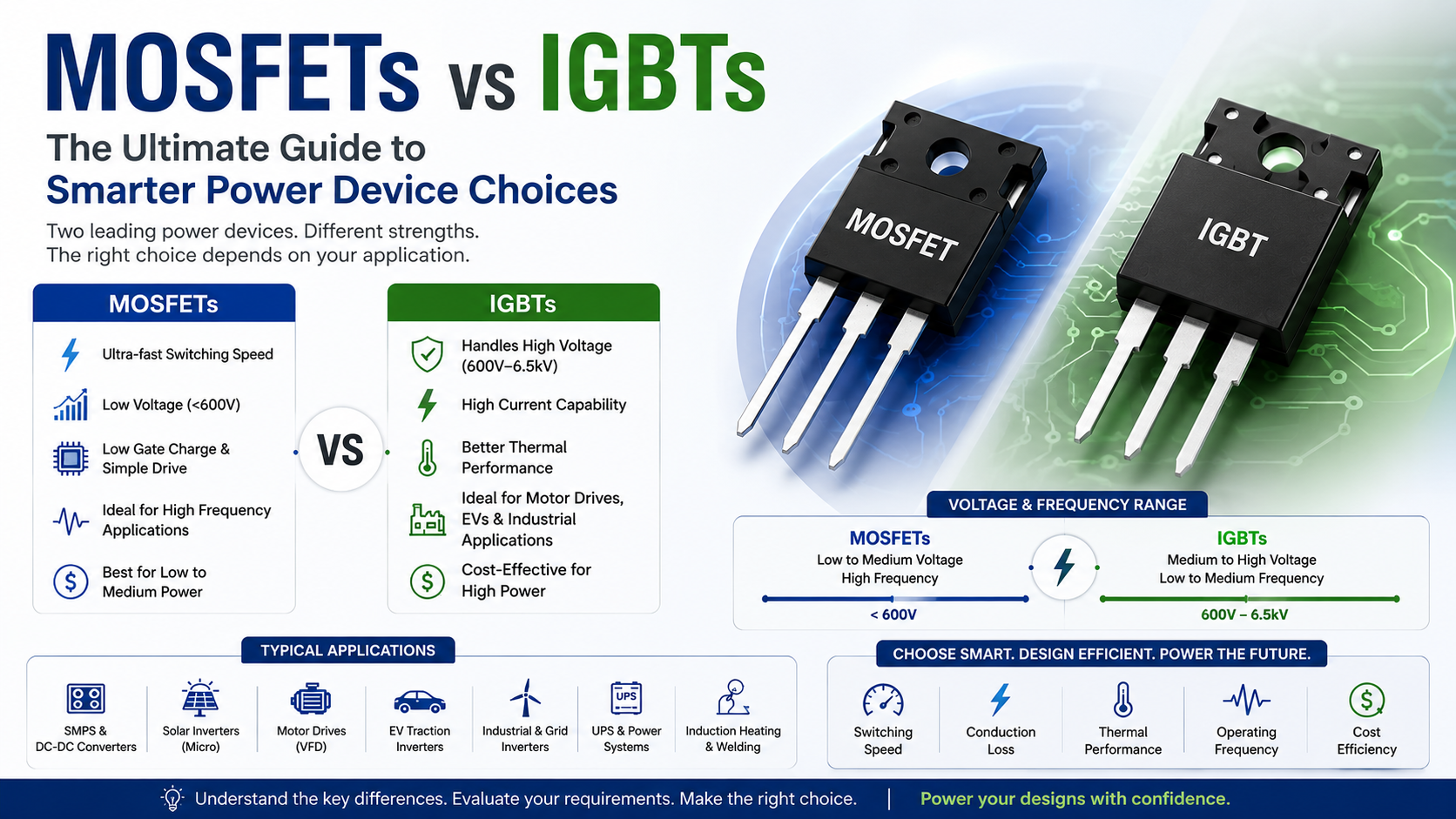
MOSFETs vs IGBTs: The Ultimate Guide to Smarter Power Device Choices
Posted: May 28, 2026
When designing power electronics systems, one of the most critical decisions you will face is choosing the right switching device. The debate around MOSFETs vs IGBTs has been central to power electronics engineering for decades — and for good reason. Both devices are workhorses of modern power conversion, yet each excels in different operating conditions.
Whether you are designing an EV inverter, a switch-mode power supply, a solar inverter, or an industrial motor drive, selecting the wrong device can result in poor efficiency, excessive heat, premature failure, or ballooning costs. This guide gives you a practical, expert-level framework for choosing between these two device families. Explore our full range of MOSFETs and IGBTs at Indus Technologies.
Table of Contents
1. What Are MOSFETs and IGBTs?
MOSFET — Metal-Oxide-Semiconductor Field-Effect Transistor
A MOSFET is a voltage-controlled semiconductor switch. It operates by applying a voltage to its gate terminal, which creates an electric field that controls current flow between the drain and source. MOSFETs are unipolar devices — current is carried by only one type of charge carrier. This single-carrier mechanism gives MOSFETs very fast switching speeds and low gate drive requirements.
Modern power MOSFETs, particularly those based on Super Junction (SJ) or Wide Bandgap (WBG) technologies like Silicon Carbide (SiC) and Gallium Nitride (GaN), have dramatically improved on-resistance (RDS(on)) values, making them extremely efficient in low-to-medium voltage applications.
IGBT — Insulated Gate Bipolar Transistor
An IGBT is essentially a hybrid device that combines the easy voltage-controlled gate drive of a MOSFET with the high current-handling capability of a Bipolar Junction Transistor (BJT). It is a bipolar device — current is carried by both electrons and holes. This conductivity modulation allows IGBTs to handle much higher voltages and currents than conventional MOSFETs at a lower on-state voltage drop (VCE(sat)).
IGBTs are typically found in applications above 600 V and in systems where high current density is more critical than switching speed. They have become the dominant switching device in high-power industrial and traction applications.
2. MOSFETs vs IGBTs — Core Technical Differences
Understanding the fundamental differences helps engineers make informed design decisions from the outset. The comparison table in Section 5 summarizes these distinctions — let us first explore each dimension in depth.
Switching Speed
MOSFETs switch significantly faster than IGBTs. Their unipolar nature means there is no minority carrier storage effect — the primary cause of IGBT's tail current during turn-off. MOSFETs can switch at frequencies exceeding 1 MHz in advanced designs, while most IGBTs are limited to 20–50 kHz in practical applications (up to 150 kHz for fast-switching variants).
Conduction Losses
At low voltages (typically below 250–400 V), a MOSFET's RDS(on) conduction loss is lower than an IGBT's VCE(sat) drop. However, as voltage ratings rise, the RDS(on) of a silicon MOSFET increases sharply, making IGBTs more efficient at higher voltages.
Gate Drive Complexity
Both devices are voltage-controlled and use insulated gates. However, MOSFETs are generally more forgiving — their gate threshold voltage is lower and gate charge is smaller. IGBTs require more careful gate resistor selection to manage dV/dt and avoid latch-up or short-circuit issues.
Thermal Performance
IGBTs typically have superior current density and better thermal performance at high power levels, which is why they dominate in traction and industrial drives. MOSFETs, especially SiC variants, are rapidly closing this gap, but silicon MOSFETs still fall short in very high voltage, high power scenarios.
3. Advantages and Disadvantages of MOSFETs
Advantages
- Ultra-fast switching speeds, enabling high-frequency designs
- Lower gate charge and simpler gate drive circuitry
- No minority carrier storage — no tail current at turn-off
- Excellent at low voltages (below ~400 V)
- Superior performance with SiC and GaN variants for high-efficiency systems
- Easy paralleling due to positive temperature coefficient of RDS(on)
Disadvantages
- RDS(on) increases sharply with voltage rating in silicon devices
- Less cost-effective above 600 V in silicon technology
- Body diode has poor reverse recovery in standard silicon MOSFETs
- More sensitive to ESD and gate oxide damage compared to IGBTs
4. Advantages and Disadvantages of IGBTs
Advantages
- Handles high voltages (600 V to 6.5 kV) and high currents cost-effectively
- Low VCE(sat) at high voltages reduces conduction losses in medium-to-high power applications
- High current density — ideal for compact, high-power modules
- Cost-effective for applications in the 1–10 kW+ range at elevated voltages
- Excellent short-circuit withstand capability
Disadvantages
- Slower switching due to minority carrier storage and tail current
- Higher switching losses limit maximum operating frequency
- Cannot be used effectively above ~150 kHz in standard designs
- Requires careful gate drive design to prevent latch-up
- Not suitable for very low voltage applications where MOSFETs dominate
5. Head-to-Head Comparison Table
| Parameter | MOSFET | IGBT |
|---|---|---|
| Switching Speed | Very Fast (up to MHz) | Moderate (≤150 kHz) |
| Voltage Range | Low–Medium (<600 V Si) | Medium–High (600 V–6.5 kV) |
| Conduction Loss (Low V) | Low | Higher |
| Conduction Loss (High V) | High | Low |
| Gate Drive | Simple | Moderate Complexity |
| Current Density | Moderate | High |
| Tail Current | None | Present |
| Parallel Operation | Easy | Requires Care |
| Cost (High Voltage) | Higher (Si) | Lower |
| Typical Applications | SMPS, DC-DC, GaN/SiC | Inverters, Drives, EVs |
6. Typical Applications
Where MOSFETs Excel
MOSFETs dominate in low-to-medium voltage, high-frequency applications:
- Switch-Mode Power Supplies (SMPS) operating at 12–400 V
- DC-DC converters in consumer electronics and telecom equipment
- Class D audio amplifiers requiring fast, precise switching
- Battery management systems (BMS) in portable electronics
- GaN/SiC-based high-efficiency inverters for solar microinverters
- Low-voltage motor control for drones and robotics
Where IGBTs Excel
IGBTs are the device of choice for medium-to-high voltage, high-power applications:
- Electric vehicle (EV) traction inverters (400 V–800 V DC bus)
- Industrial variable-frequency drives (VFDs) for motor control
- Grid-tied solar and wind inverters (above 1 kW)
- Uninterruptible Power Supplies (UPS)
- Induction heating and welding equipment
- High-voltage direct current (HVDC) transmission systems
7. How to Choose: MOSFETs vs IGBTs Decision Criteria
Use the following structured framework to evaluate your specific application:
Step 1 — Determine Operating Voltage
This is the single most important filter. Below 250 V, MOSFETs (especially GaN or SiC) are almost always the better choice. Between 250–600 V, careful loss analysis is required. Above 600 V, IGBTs generally win unless you are using SiC MOSFETs.
Step 2 — Evaluate Switching Frequency
If your design operates above 50–100 kHz, MOSFETs are typically the only viable silicon option. IGBTs are unsuitable for high-frequency operation due to tail current losses that increase proportionally with frequency. For low-frequency applications (below 20 kHz), IGBTs can provide excellent conduction efficiency.
Step 3 — Calculate Total Power Loss
Perform a full loss analysis including conduction losses, switching losses, gate drive losses, and reverse recovery losses. At the crossover voltage range (250–600 V), a careful simulation will reveal which device truly wins for your specific duty cycle and load profile.
Step 4 — Consider Thermal Budget
IGBTs offer higher current density, advantageous when constrained by package size or heat sink space. MOSFETs, particularly SiC, can operate at higher junction temperatures, which can simplify thermal management in demanding environments.
Step 5 — Factor in Cost and Availability
For high-voltage applications, IGBTs are significantly cheaper per ampere than silicon MOSFETs. SiC MOSFETs offer compelling performance advantages above 600 V, but at a premium cost that must be justified by system efficiency gains or reduced cooling requirements. Explore power device options at Industechno for competitive pricing and availability.
8. FAQ — MOSFETs vs IGBTs
Conclusion
The choice between MOSFETs vs IGBTs is never one-size-fits-all. It depends on your operating voltage, switching frequency, power level, thermal constraints, and cost targets. MOSFETs are the clear winners for low-voltage, high-frequency applications, while IGBTs remain unrivaled in high-voltage, high-current power conversion at moderate switching frequencies.
As Wide Bandgap semiconductors continue to mature, the boundary between these two technologies will keep shifting — but a solid understanding of the fundamental trade-offs between MOSFETs vs IGBTs will always be an essential skill for any power electronics engineer.
Need help selecting the right device for your design? Indus Technologies, the complete electronic parts supplier in Bangalore, carries a wide range of MOSFETs, IGBTs, and all associated power electronics components — from gate driver ICs to thermal management solutions. Make a confident, informed choice with expert sourcing support.
-

-

November 27, 2025
Connecting the Dots: How Electronic Components Work Together in Devices -

November 27, 2025
How reliable is your electronics components supplier