

Sensors in Modern Electronics: Types, Working Principles & How to Choose the Right One for Your Application

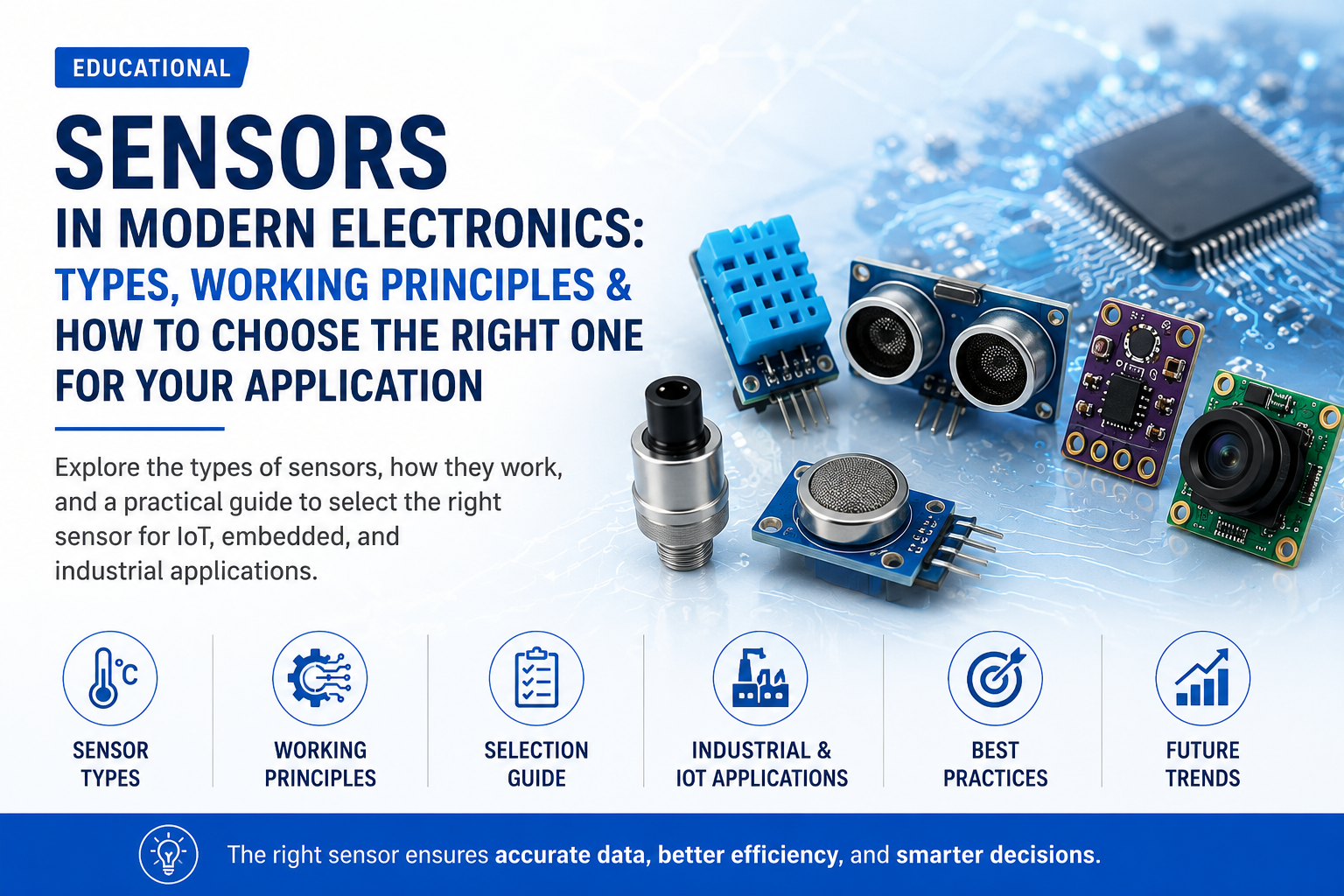
Sensors in Modern Electronics: Types, Working Principles & How to Choose the Right One for Your Application
Sensors are the sensory organs of every modern electronic system. From the accelerometer that reorients your phone's screen to the pressure sensor keeping an industrial pump within safe limits, sensors quietly convert the physical world into signals that microcontrollers can understand and act on. Yet with hundreds of sensor types and dozens of interface options available, choosing the right one for a given application is rarely straightforward.
This guide breaks down how sensors work, the major categories you'll encounter as a product designer, IoT developer, or electronics engineer, and a practical framework for narrowing down the right sensor for your next design.
"The best sensor for your application isn't the most accurate one on the datasheet — it's the one that reliably meets your accuracy, power, and cost targets in the real environment your product will live in."
Table of Contents
- Introduction to Sensors in Electronics
- Types of Sensors Used in Modern Electronics
- Working Principles Behind Common Sensors
- Analog vs. Digital Sensors
- Sensor Selection Guide
- Industrial and IoT Applications
- Common Challenges When Working With Sensors
- Best Practices for Sensor Integration
- Future Trends in Sensor Technology
- Conclusion
- Frequently Asked Questions
| 1 | Introduction to Sensors in Electronics |
A sensor is a device that detects a physical or chemical quantity — temperature, light, pressure, motion, gas concentration — and converts it into an electrical signal that a circuit can process. That signal might be a varying voltage, a current, a resistance change, or a digital data stream, depending on the sensor's design.
Sensors sit at the boundary between the physical and digital worlds. In a smart thermostat, a temperature sensor feeds data to a microcontroller that decides whether to trigger heating. In a factory, a proximity sensor tells a PLC whether a part has reached the correct position on a conveyor. In a wearable, an optical heart-rate sensor turns light absorption patterns into a continuous stream of biometric data.
As embedded systems, IoT devices, and automation continue to expand into nearly every industry, understanding sensor types and their working principles has become essential knowledge for anyone designing connected products.
| 2 | Types of Sensors Used in Modern Electronics |
Sensors are typically grouped by the physical quantity they measure. Below are the categories most relevant to product design and embedded engineering.
2.1 Temperature Sensors
Thermistors, RTDs (resistance temperature detectors), and semiconductor sensors like the LM35 or DS18B20 measure heat by exploiting predictable changes in resistance or voltage with temperature. These are used everywhere from HVAC systems to battery management circuits.
2.2 Motion and Inertial Sensors
Accelerometers, gyroscopes, and combined Inertial Measurement Units (IMUs) detect acceleration, orientation, and rotational velocity. They're core components in wearables, drones, and vehicle stability systems.
2.3 Proximity and Position Sensors
Inductive, capacitive, and Hall-effect sensors detect the presence or position of an object without physical contact. Hall-effect sensors, in particular, are widely used for contactless switches and rotary position sensing.
2.4 Light and Optical Sensors
Photodiodes, phototransistors, and ambient light sensors convert light intensity into electrical signals, enabling applications like automatic display brightness, presence detection, and optical encoders.
2.5 Pressure and Force Sensors
Piezoresistive and capacitive pressure sensors measure fluid or gas pressure, while load cells and strain gauges measure mechanical force. These are common in industrial process control and weighing systems.
2.6 Humidity and Gas Sensors
Capacitive humidity sensors and electrochemical or metal-oxide gas sensors detect moisture and airborne chemical concentrations, critical for environmental monitoring, HVAC, and safety systems that detect gases like CO or LPG.
Sensor Type vs. Typical Application
| Sensor Type | Typical Application |
|---|---|
| Temperature Sensor | HVAC, battery management, industrial process control |
| IMU (Accelerometer + Gyroscope) | Wearables, drones, vehicle stability |
| Hall-Effect Sensor | Contactless switches, motor commutation, position sensing |
| Ambient Light Sensor | Display brightness control, presence detection |
| Pressure Sensor | Industrial process control, altimeters, tire monitoring |
| Gas Sensor | Safety monitoring, air quality, industrial leak detection |
| 3 | Working Principles Behind Common Sensors |
Despite the variety, most sensors rely on a handful of core physical effects to translate a stimulus into a measurable electrical output:
- Resistive change: Thermistors and strain gauges change resistance in response to temperature or mechanical deformation.
- Capacitive change: Humidity and proximity sensors detect changes in capacitance as a dielectric material (like water vapor) or a nearby object alters the electric field between plates.
- Piezoelectric effect: Certain crystals generate a voltage when mechanically stressed, used in vibration and some pressure sensors.
- Hall effect: A magnetic field deflects charge carriers in a conductor, producing a measurable voltage proportional to field strength.
- Photoelectric effect: Light striking a semiconductor junction generates or modulates current, the basis for photodiodes and optical sensors.
The raw signal from these effects is usually small and noisy, so most sensors include on-board signal conditioning — amplification, filtering, and sometimes analog-to-digital conversion — before the data reaches a microcontroller.
Key Takeaway: Nearly every sensor ultimately converts a physical effect — resistive, capacitive, piezoelectric, magnetic, or optical — into a voltage or current your circuit can interpret. Understanding this at a conceptual level makes datasheet comparisons far easier.
| 4 | Analog vs. Digital Sensors |
One of the earliest decisions in sensor selection is whether to use an analog or digital output sensor. Both have a place, and the right choice depends on your system architecture and noise environment.
| Criteria | Analog Sensors | Digital Sensors |
|---|---|---|
| Output | Continuous voltage/current | I2C, SPI, UART data |
| Noise Susceptibility | Higher, especially over long wires | Lower, signal is already conditioned |
| Wiring Complexity | Simple, needs ADC channel | Needs a bus interface and driver/firmware |
| Multiple Sensors on One Line | Difficult, one ADC channel per sensor | Easy, multiple devices share a bus |
| Typical Cost | Generally lower | Slightly higher due to on-chip ADC/logic |
| 5 | Sensor Selection Guide |
Choosing the right sensor comes down to matching its specifications to your application's real-world constraints. Work through this checklist during the design phase:
- Measurement range and resolution: Confirm the sensor covers your full expected input range with enough resolution for meaningful readings.
- Accuracy vs. precision requirements: A high-precision but poorly calibrated sensor may not suit safety-critical applications; understand your tolerance for error.
- Power consumption: Battery-powered and energy-harvested IoT devices demand ultra-low quiescent current and efficient sleep modes.
- Interface compatibility: Check whether your microcontroller supports the sensor's bus (I2C, SPI, analog) and whether address conflicts exist on a shared bus.
- Environmental durability: Consider operating temperature range, IP rating for dust/moisture, and vibration tolerance for industrial or outdoor use.
- Response time: Fast-changing measurements like vibration or flow require sensors with sufficiently high sampling rates.
- Cost and sourcing: Factor in unit cost at your production volume and confirm long-term availability from an authorized distributor.
Expert Tip: Always validate a sensor against your actual operating environment before committing to a design. A sensor that performs well in a lab at 25°C may drift significantly at the temperature extremes your product will actually see in the field.
| 6 | Industrial and IoT Applications |
Sensors are the foundation of both industrial automation and the broader IoT ecosystem:
- Predictive maintenance: Vibration and temperature sensors on rotating machinery detect early signs of bearing wear or misalignment before failure occurs.
- Smart agriculture: Soil moisture and environmental sensors enable precision irrigation and climate monitoring across large fields.
- Smart buildings: Occupancy, light, and air-quality sensors drive automated HVAC and lighting control for energy efficiency.
- Process control: Pressure and flow sensors provide real-time feedback for closed-loop control in manufacturing lines.
- Wearable health devices: Optical and motion sensors track heart rate, activity, and sleep patterns continuously and unobtrusively.
| 7 | Common Challenges When Working With Sensors |
Even experienced designers run into recurring issues when integrating sensors:
- Sensor drift: Long-term exposure to temperature swings or aging can shift baseline readings, requiring periodic recalibration.
- Electrical noise: Long analog wiring runs near motors or switching power supplies can corrupt readings; shielding and filtering are often necessary.
- Cross-sensitivity: Some sensors respond to more than the target quantity — a humidity sensor reacting to temperature, for example — complicating calibration.
- Bus conflicts: Multiple I2C sensors sharing the same fixed address require external multiplexers or address-configurable variants.
- Power budget overruns: Underestimating peak current draw during sensor sampling can drain battery-powered devices faster than expected.
Common Mistake: Skipping datasheet review of a sensor's settling time and sampling response can lead to systems that appear to work in testing but produce lagging or inaccurate readings once deployed in real conditions.
| 8 | Best Practices for Sensor Integration |
- Keep analog sensor wiring as short as possible, and use twisted-pair or shielded cable in electrically noisy environments.
- Apply digital filtering (moving average, Kalman filters for motion data) in firmware to smooth out sensor noise.
- Include decoupling capacitors close to the sensor's power pins to stabilize supply voltage during sampling.
- Plan for calibration routines, especially for sensors with known drift characteristics over time or temperature.
- Design in sensor redundancy for safety-critical measurements where a single point of failure is unacceptable.
Industry Insight: As IoT deployments scale into the thousands of nodes, sensor power consumption and bus efficiency often matter more than raw accuracy — a lesson many teams learn only after their first large field deployment.
| 9 | Future Trends in Sensor Technology |
Sensor technology continues to evolve rapidly, and several trends are shaping the next generation of designs:
- Sensor fusion and edge AI: Combining data from multiple sensors with on-device machine learning to extract richer insights while reducing cloud dependency.
- MEMS miniaturization: Micro-electromechanical systems continue shrinking, enabling more sensors to be packed into smaller wearable and mobile form factors.
- Energy harvesting: Ultra-low-power sensor nodes increasingly draw power from ambient light, vibration, or RF energy, reducing battery dependency.
- Self-calibrating sensors: Built-in intelligence that compensates for drift and environmental variation automatically, reducing maintenance overhead.
| 10 | Conclusion |
Sensors form the foundation of nearly every modern electronic product, translating temperature, motion, light, pressure, and countless other physical quantities into signals that drive intelligent behavior. Understanding the core working principles, the tradeoffs between analog and digital designs, and a structured selection process will help you avoid costly redesigns and choose sensors that hold up in real-world conditions.
Whether you're building a single IoT prototype or specifying components for a large-scale industrial deployment, sourcing genuine, well-documented sensors from a trusted distributor is just as important as the technical selection process itself.
| 11 | Frequently Asked Questions |
Q1: What is the difference between a sensor and a transducer?
A sensor detects a physical quantity and converts it into a signal, which is technically a form of transducer. In practice, "transducer" is often used more broadly to include devices that convert energy in either direction, such as actuators, while "sensor" typically refers specifically to measurement devices.
Q2: Which sensor interface is best for a battery-powered IoT device?
I2C or SPI digital sensors with low quiescent current and configurable sleep modes are generally preferred, since they minimize both wiring overhead and standby power draw compared to continuously-powered analog sensors.
Q3: How do I prevent noise in analog sensor readings?
Keep analog wiring short, use shielded or twisted-pair cable near noisy equipment, add decoupling capacitors near the sensor's power pins, and apply firmware-level filtering such as a moving average or low-pass filter.
Q4: What is sensor fusion and why does it matter?
Sensor fusion combines data from multiple sensors, such as an accelerometer and gyroscope, to produce more accurate and stable readings than any single sensor could achieve alone. It's widely used in motion tracking, robotics, and navigation systems.
Q5: How often should industrial sensors be recalibrated?
Calibration frequency depends on the sensor type, environmental exposure, and application criticality, but many industrial deployments follow a schedule of every 6 to 12 months, guided by the manufacturer's stated drift specifications and any regulatory requirements.
Suggested Internal Linking Opportunities
- Top 5 Things to Check Before Buying Electronic Components Online
- Getting Started with Arduino
- Temperature Sensors category page
- Hall Effect Sensors category page
- How Electronic Components Work Together in Devices
References
- Texas Instruments – Sensor and Signal Chain design resources
- STMicroelectronics – MEMS and Sensors documentation
- IEEE Sensors Journal – peer-reviewed sensor research
- NIST – Measurement science and calibration standards
-

-

November 27, 2025
Connecting the Dots: How Electronic Components Work Together in Devices -

November 27, 2025
How reliable is your electronics components supplier