

Top 5 Things to Check Before Buying Electronic Components Online

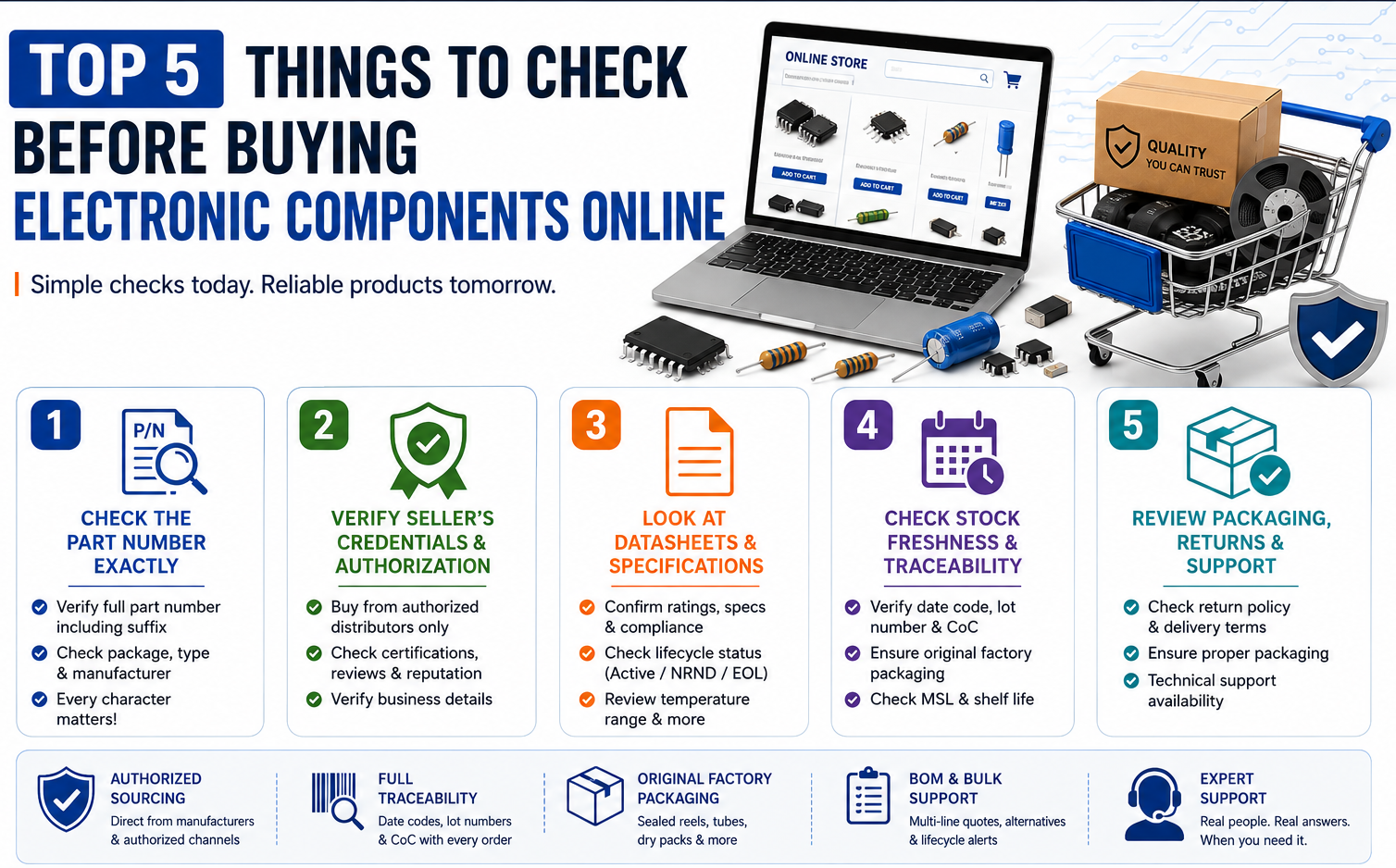
Top 5 Things to Check Before Buying Electronic Components Online
Online procurement has completely changed the way engineers and buyers source electronic components. What used to mean phone calls, catalogue binders, and weeks of back-and-forth can now happen in a few clicks. That’s genuinely great.
But here’s the flip side: it has also made it easier than ever to accidentally order the wrong part, end up with substandard stock, or — in the worst case — receive counterfeit components that look fine until they fail in your product.
Whether you are a seasoned procurement manager handling a 500-line BOM or a hobbyist picking up components for a weekend project, the risks of buying electronic components online without a proper checklist are real. This post walks you through five things you should always verify before placing that order — simple checks that can save you serious time, money, and frustration.
“A few minutes of diligence before you click ‘Buy’ can save days of debugging and production delays after the order arrives.”
Table of Contents
- Check the Part Number — Exactly
- Verify the Seller’s Credentials and Authorization
- Look at the Datasheets and Specifications
- Check Stock Freshness — Date Codes and Traceability
- Review Packaging, Returns, and After-Sales Support
- Quick Pre-Order Checklist
- Why This Matters — And How Indus Technologies Helps
- FAQ — Buying Electronic Components Online
Check the Part Number — Exactly
This sounds so obvious that it barely seems worth saying — until you’ve ordered the wrong component and paid express shipping to get it in time for production. Part number errors are the single most common and entirely preventable mistake when buying electronic components online.
Semiconductor part numbers are dense with information. Take something like TPS54331DR versus TPS54331D — one is a reel, the other a tube. Or ATMEGA328P-AU versus ATMEGA328P-PU — one is surface mount, the other is DIP through-hole. Different packages, different footprints, completely different board design implications.
What to check:
- Full part number including suffix: Every character matters — package code, temperature grade, tape-and-reel indicator. Cross-check the listing against the manufacturer’s official datasheet.
- Package type: SMD or through-hole? SOT-23, SOIC, QFN, TO-220? Confirm the package matches your PCB footprint before ordering.
- Manufacturer: Two different manufacturers can share similar part numbers. Make sure the listed manufacturer is the one your design was qualified with.
- Equivalent or substitute flag: Some listings silently offer a “functional equivalent” or “drop-in replacement.” Unless you have qualified the substitute, always insist on the exact original part.
Verify the Seller’s Credentials and Authorization
Not all online component sellers are created equal. The electronic components market has a well-known grey market problem — there are countless third-party sellers and brokers out there, and some of them are moving stock that is refurbished, remarked, or simply fake.
When you are buying electronic components online, knowing who you are buying from matters as much as knowing what you are buying. The gold standard is purchasing from an authorized distributor — a company that sources components directly from the manufacturer under a formal distribution agreement, with full factory-level traceability from the production lot to your door.
Here is what to look for:
- Authorized distributor status: Check whether the seller is listed as an authorized distributor on the manufacturer’s official website. Most major manufacturers (Texas Instruments, STMicroelectronics, Infineon, Murata) publish their authorized distributor lists publicly.
- Business registration and physical presence: Does the seller have a real address, a company registration number, and verifiable contact details? Anonymous-looking online stores with no clear business identity are a risk.
- Customer reviews and reputation: Look beyond the seller’s own website — check Google reviews, industry forums, and peer recommendations. A supplier that engineers in your industry trust is a green flag.
- Certifications: ISO 9001 certification is a basic indicator of quality management discipline. For specialized industries, look for AS6081, CCAP-101, or equivalent anti-counterfeiting certifications.
⚠️ If a deal looks too good to be true — deeply discounted pricing, immediate availability for a part that’s been on allocation for months — that’s your signal to ask more questions, not fewer.
Look at the Datasheets and Specifications
Before you buy, read the datasheet. It sounds basic, but you would be surprised how many component purchases go wrong simply because someone assumed compatibility without checking the specs. When buying electronic components online, you cannot touch or test the part before it arrives — the datasheet is your pre-purchase inspection.
Key things to verify against your design requirements:
- Voltage and current ratings: Make sure the component’s maximum ratings exceed your application conditions with appropriate derating margins — typically 20–30% headroom for reliable long-term operation.
- Temperature range: Commercial grade (0°C to 70°C), industrial grade (−40°C to 85°C), or automotive grade? Using a commercial-grade part in an industrial environment is a reliability time bomb.
- RoHS and compliance status: For export or regulated markets — especially Europe — confirm whether the part meets RoHS, REACH, or other relevant directives. Non-compliant parts can block your product’s market entry entirely.
- Revision and errata: Check whether you are looking at the latest datasheet revision. Some parts have silicon errata (known bugs) in older revisions — your design workarounds may depend on the specific revision.
- Lifecycle / product status: Is the part active, not recommended for new designs (NRND), or end-of-life (EOL)? Ordering a part that’s being discontinued could force a costly redesign six months from now.
Most reputable sellers link to the official manufacturer datasheet directly on the product listing page. If a seller cannot or will not provide a datasheet, that tells you something important.
Check Stock Freshness — Date Codes and Traceability
This is the check that separates experienced buyers from beginners — and it is one of the most important things to verify when buying electronic components online. “Stock” does not always mean “fresh stock.”
Components have a shelf life, particularly moisture-sensitive devices (MSDs). Electrolytic capacitors degrade over time. Lead finishes oxidize. Old reels that have been stored improperly can cause solderability failures, delamination during reflow, or early field failures.
What traceability means in practice:
- Date code: The date code tells you when the component was manufactured. Ask for it before ordering, especially for large quantities. Inconsistent date codes across a batch is a major red flag for recycled or suspect components.
- Lot number: A verifiable lot number traces the component back to its original production run. This allows cross-checking against the manufacturer’s records if questions arise later.
- Certificate of Conformance (CoC): A proper CoC documents that the parts were manufactured to specification, tested, and shipped from an authorized facility. Always request this for production-critical components.
- Original factory packaging: Genuine new components come in sealed factory packaging — original reels with manufacturer labels, moisture barrier bags with desiccant for MSDs, or manufacturer-labeled tubes and trays. Loose parts in unmarked anti-static bags are a warning sign.
???? For moisture-sensitive devices, always check whether the floor life has been consumed. A sealed, unexpired dry bag with intact humidity indicator is a good sign. A dry bag that’s been opened or has a pink indicator tells you to bake the components before assembly — or reconsider the order entirely.
Review Packaging, Returns, and After-Sales Support
The fifth check is one that buyers often skip — and then wish they had not. When buying electronic components online, what happens after the order arrives matters just as much as the order itself.
Things can go wrong. A batch can arrive damaged. A part might not perform to spec. An unexpected shortage might mean you only receive half your quantity. A good supplier handles these situations professionally. A bad one disappears.
What to check before you commit:
- Return and rejection policy: Can you return components that fail incoming inspection or do not match what was listed? What is the process — and what is the timeframe? A supplier with no clear returns policy is a risk for production-scale purchasing.
- Packaging integrity: How are components packed for shipping? ESD-sensitive parts should be in anti-static packaging. Reels should be secured to avoid damage in transit. Components shipped loose in a padded envelope is not acceptable for production stock.
- Shipping and delivery commitments: Does the seller provide a realistic delivery timeframe? Do they offer tracking? For time-critical production builds, confirm lead time in writing before placing the order.
- Technical support availability: If you have a question about a component’s suitability for your application, can you actually get a knowledgeable answer from the supplier? Good technical support is a sign of a supplier who understands what they are selling.
- BOM and bulk quote support: For production teams managing large BOMs, check whether the supplier can handle multi-line bulk quotes, offer alternative part suggestions for hard-to-find items, and maintain a reliable supply pipeline across multiple orders.
Quick Pre-Order Checklist
Before you click Buy on your next component order, run through this:
| ✓ | Pre-Order Checklist — Buying Electronic Components Online |
|---|---|
| ☐ | Full part number confirmed — including suffix, package code, and reel/tube indicator |
| ☐ | Part number cross-checked against official manufacturer datasheet |
| ☐ | Seller is an authorized distributor (verified on manufacturer’s website) |
| ☐ | Seller has verifiable business credentials, address, and contact details |
| ☐ | Datasheet reviewed — voltage, current, temperature range, and compliance status confirmed |
| ☐ | Product lifecycle status checked — part is active and not NRND or EOL |
| ☐ | Date code and lot number requested and verified as consistent |
| ☐ | Certificate of Conformance (CoC) confirmed available with the order |
| ☐ | Original factory packaging confirmed — sealed reel, tube, or dry pack |
| ☐ | Return and rejection policy reviewed and acceptable |
| ☐ | Delivery timeframe confirmed in writing |
| ☐ | Technical support contact available for post-purchase questions |
Why This Matters — And How Indus Technologies Helps
At Indus Technologies, we see both sides of this. We hear from engineers and procurement teams every week who’ve had a bad experience somewhere else — wrong parts, suspect stock, no support after the sale. And we’ve built our entire business specifically to prevent exactly that.
When you buy electronic components online through Indus Technologies, here’s what you get by default:
- Authorized sourcing: We source directly from manufacturers and authorized distribution networks — never from grey market brokers.
- Full traceability: Every order includes date codes, lot numbers, and Certificate of Conformance documentation.
- Original factory packaging: Sealed reels, manufacturer-labeled tubes, and proper moisture-sensitive device handling.
- BOM support: Need a 200-line BOM quoted quickly? Our team handles multi-line requests and flags lifecycle issues or alternative suggestions proactively.
- Real technical support: You can actually reach us — and get a meaningful answer, not a ticket number.
Whether you need a single hard-to-find IC or a full production run supply, explore our component catalog or submit a bulk quote request and let us take the guesswork out of online component sourcing.
FAQ — Buying Electronic Components Online
Q1: Is it safe to buy electronic components online?
Yes — if you buy from reputable, authorized sources. The risk is not with online purchasing itself but with where you buy from. Authorized distributors, established platforms with proper vetting, and direct manufacturer stores are all safe options. Random brokers on open marketplaces with no verifiable credentials carry significant counterfeit and quality risk.
Q2: What is the most common mistake people make when buying components online?
Not verifying the full part number before ordering. The difference between similar-looking part numbers can mean different packages, temperature grades, or performance specifications — and realizing that after the order arrives can stall production. Always cross-check the exact part number against the official datasheet before committing.
Q3: How do I know if a component seller is an authorized distributor?
Go to the manufacturer’s official website and look for their “Where to Buy” or “Authorized Distributors” page. Major manufacturers like Texas Instruments, STMicroelectronics, Infineon, and Murata maintain these lists publicly. If a seller is not on that list, they are sourcing through secondary channels — which may or may not be acceptable depending on your quality requirements.
Q4: What is a Certificate of Conformance and why does it matter?
A Certificate of Conformance (CoC) is a document provided by the manufacturer or authorized distributor confirming that a batch of components meets specified quality and performance requirements, traceable back to a specific manufacturing lot. It matters because it gives you documented evidence of authenticity and quality — particularly important for safety-critical applications and for defending against potential warranty or liability claims.
Q5: Should I be concerned about moisture-sensitive components bought online?
Yes, and especially so when buying from unknown sources. Moisture-sensitive devices (MSDs) must be stored in dry conditions and used within a specific floor life after opening. If a seller cannot confirm proper storage conditions or provide a sealed dry bag with an intact humidity indicator card, the components may have absorbed moisture — which can cause delamination or voids during reflow soldering. When in doubt, bake the components before assembly.
Q6: What should I do if the components I receive do not match what I ordered?
Document everything immediately — photograph the packaging, the component markings, the shipping label, and any accompanying paperwork. Contact the supplier with this documentation and request either a replacement or a refund under their returns policy. If you suspect the parts are counterfeit, quarantine the stock and report it to ERAI (erai.com) or your local standards body. Do not use suspect components in production under any circumstances.
Q7: Can I trust small or local Indian suppliers for electronic components?
Absolutely — some of the most reliable sourcing in India comes from established local distributors who have built their reputation over many years with verified supply chains and direct manufacturer relationships. The key is not whether a supplier is local or international, but whether they can demonstrate authorized sourcing, proper documentation, and consistent quality. Ask for references, check certifications, and start with a small order if you are evaluating a new supplier.
Final Thoughts
Buying electronic components online should be convenient — not stressful. And with a consistent pre-purchase routine, it genuinely can be. Five checks: right part number, verified seller, confirmed specs, traceable stock, and a supplier who supports you after the sale. That’s really all it takes to make most of the common mistakes avoidable.
Build these checks into your procurement process as habits, and you will spend far less time chasing bad orders and far more time building great products.
At Indus Technologies, we are here to make online component sourcing straightforward, reliable, and — frankly — much less stressful.
-

-

November 27, 2025
Connecting the Dots: How Electronic Components Work Together in Devices -

November 27, 2025
How reliable is your electronics components supplier